




Databricks Certifications: A Quick Guide for Top Exams and Career Paths for 2026

Table of content
- <strong>What Is Databricks, and What Is the Importance of Databricks Certifications?</strong>
- <strong>Why Databricks Skills Are in Demand</strong>
- <strong>Top 5 Databricks Certification Courses in 2026</strong>
- <strong>How to Prepare for Databricks Examinations in 2026?</strong>
- <strong>Choose the Right Exams to Stand Out and Grow in Your Career</strong>
- FAQ
If you work with data, you have likely seen Databricks listed in job descriptions for data engineers, analytics engineers, and even data scientists.
Companies use it to process large datasets, build pipelines, and run analytics at scale. As such, Databricks certifications now carry real weight in the job market.
But choosing the right Databricks certification is not ever simple. There are multiple exams. Some focus on data engineering, others on analytics or machine learning. All these can make picking the right Databricks course a challenge.
Our goal here is to help you navigate all these challenges with this guide. Here, you will learn:
- What are the top Databricks certifications courses in 2026
- Who should take each of the courses being discussed
- How each course fits into different career paths
- How to prepare for Databricks certifications in 2026
Whether you have just taken an Azure data engineer course or are already working with data, this guide is for you.
What Is Databricks, and What Is the Importance of Databricks Certifications?

Databricks is a cloud-based data platform built on Apache Spark. It helps teams store, process, and analyze large volumes of data in one place.
Instead of using separate tools for data engineering, analytics, and ML, Databricks brings everything together. Companies use Databricks for a range of purposes, chiefly for:
- Building data pipelines
- Cleaning and transforming data
- Running analytics workloads
The platform integrates with major cloud providers like Azure, AWS, and Google Cloud. This makes Databricks a preferred tool in most cloud-specific roles, such as Azure or AWS data engineers.
Why Databricks Skills Are in Demand

The platform’s growing use across industries has made Databricks skills highly valuable in today’s job market. Here are a few reasons why Databricks skills are in demand:
- Businesses generating large volumes of data need platforms that scale without performance issues.
- Employers now need data professionals with experience in Spark, distributed computing, and cloud-based data pipelines.
- A Databricks certification helps validate these skills in a structured, recognized way that you can use as credentials.
For learners coming from a data engineer course or cloud training, Databricks is a natural next step in career growth.
Top 5 Databricks Certification Courses in 2026

1. Databricks Certified Data Engineer Professional

This certification is designed for experienced data engineers working with large-scale, production data systems on Databricks. It validates advanced, hands-on skills rather than basic theory.
- Validity: 2 years
- Registration fee: $200
- Type of exam: Proctored exam
- Examination duration: 120 minutes
- No. of questions: 90 multiple choice
This certification focuses on the following key elements to help candidates develop the right Databricks skills:
- Build and maintain production-grade ETL pipelines
- Optimize performance and control infrastructure costs
- Process batch and streaming data using Python and SQL
- Implement governance, security, and schema management
- Work with Delta Lake, Unity Catalog, and Medallion Architecture
- Deploy pipelines using Databricks CLI, REST API, and Asset Bundles
The examination covers different elements taught in the course. Here is a table to quickly understand the coverage of topics:
| Sl. No. | Course | Coverage |
|---|---|---|
| 1 | Developing Code for Data Processing using Python and SQL | 22% |
| 2 | Cost & Performance Optimisation | 13% |
| 3 | Debugging and Deploying | 10% |
| 4 | Data Transformation, Cleansing, and Quality | 10% |
| 5 | Ensuring Data Security and Compliance | 10% |
| 6 | Monitoring and Alerting | 10% |
| 7 | Data Ingestion & Acquisition | 7% |
| 8 | Data Governance | 7% |
| 9 | Data Modelling | 6% |
| 10 | Data Sharing and Federation | 5% |
2. Azure Databricks Training
Azure Databricks Training helps professionals master big data processing, analytics, and machine learning on Microsoft Azure. It covers Apache Spark, data pipelines, and real-world use cases to build scalable, cloud-ready data solutions.
- Module: 14 lessons
- Duration: 30 hours
- Fee: INR 47,940 (Online classroom)
The Azure Databricks training online course provides hands-on experience with Databricks, focusing on:
- Working with Delta Lake for reliable data storage
- Core concepts of Azure Databricks and Apache Spark
- Building data pipelines using PySpark and Spark SQL
- Data ingestion from Azure Data Lake and other sources
- Managing notebooks, clusters, and jobs in Azure Databricks
3. Databricks Certified Machine Learning Associate
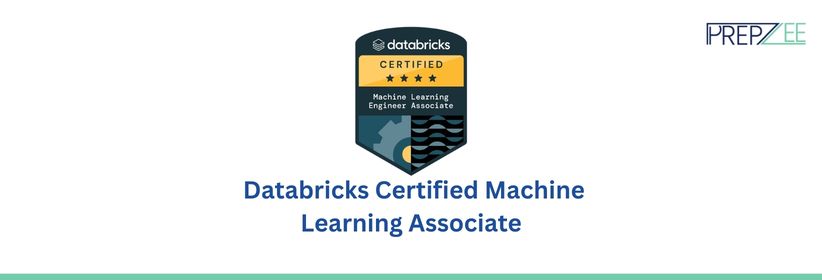
The Databricks Certified Machine Learning Associate certification validates foundational skills in building, training, and deploying machine learning models on the Databricks platform. It focuses on ML workflows, feature engineering, and model evaluation using Apache Spark.
- Validity: 2 years
- Registration fee: $200
- Time limit: 90 minutes
- Total questions: 45 multiple-choice
Key skills validated:
- Building end-to-end machine learning workflows on Databricks
- Applying feature engineering and model selection best practices
- Training and evaluating models using common ML techniques
- Understanding basic deployment and inference concepts
- Preparing and transforming data for ML use cases
- Tracking experiments and models with MLflow
Exam coverage:
| Sl. No. | Area | Coverage |
|---|---|---|
| 1 | Machine learning workflows on Databricks | 25% |
| 2 | Model training and evaluation | 25% |
| 3 | Data preparation and feature engineering | 20% |
| 4 | Experiment tracking and MLflow | 15% |
| 5 | Model deployment basics | 15% |
4. Data Management with Databricks: Big Data with Delta Lakes
Data Management with Databricks: Big Data with Delta Lakes focuses on building reliable and scalable data pipelines using Delta Lake. It covers data ingestion, versioning, and optimization to manage large-scale data efficiently.
- Validity: 2 years
- Registration fee: $200
- Type of exam: Proctored exam
- Examination duration: 120 minutes
- No. of questions: 45 multiple-choice
Key skills:
- Managing data using tools like Unity Catalog, UI ingestion, and Delta Sharing
- Ability to work with Databricks SQL and SQL Warehouses
- Creating visualizations and production-ready dashboards
- Understanding AI/BI Genie spaces and data modelling
- Applying data security best practices in Databricks
- Executing and optimizing queries for analysis
Exam coverage:
| Sl. No | Topics | Coverage |
|---|---|---|
| 1 | Executing SQL queries | 20% |
| 2 | Dashboards & visualizations | 16% |
| 3 | Analyzing queries | 15% |
| 4 | Data import & management | 13% |
| 5 | AI/BI Genie spaces | 12% |
| 6 | Databricks platform concepts | 11% |
| 7 | Data security & governance | 8% |
| 8 | Data modelling | 5% |
5. Databricks Certified Machine Learning Professional
The Databricks Certified Machine Learning Professional certification validates advanced skills in designing, building, and deploying end-to-end machine learning solutions on Databricks. It focuses on scalable ML pipelines, model governance, and production-grade ML workflows.
- Validity: 2 years
- Registration fee: $200
- Type of exam: Proctored exam
- Examination duration: 120 minutes
- No. of questions: 59 multiple-choice questions
Key skills:
- Implement distributed training and hyperparameter tuning
- Design scalable machine learning pipelines using SparkML
- Build automated feature pipelines using Feature Store concepts
- Experiment tracking and model lifecycle management with MLflow
- Implement model deployment strategies and custom model serving
- Use Lakehouse Monitoring for automated retraining and drift detection
Exam coverage:
| Sl. No | Topics | Coverage |
|---|---|---|
| 1 | Model Development | 44% |
| 2 | ML Ops | 44% |
| 3 | Model Deployment | 12% |
Read More: What Is Generative AI? A Complete Guide for Beginners
How to Prepare for Databricks Examinations in 2026?
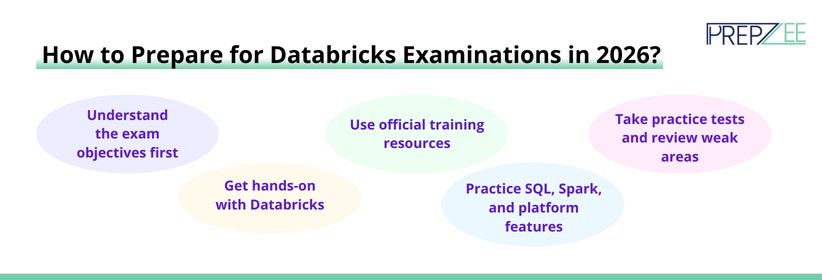
Preparing for Databricks exams in 2026 requires more than just reading documentation. Most Databricks exams are practical and role-focused. Hence, your preparation should reflect real Databricks workflows and hands-on experience.
- Understand the exam objectives first: Review official exam guides, study topic weightage, and read exam experiences.
- Get hands-on with Databricks: Build pipelines, write SQL/PySpark code, create dashboards, and train ML models.
- Use official training resources: Databricks Academy provides instructor-led and self-paced courses aligned with exams.
- Practice SQL, Spark, and platform features: Optimize queries, use Delta Lake, manage governance, and orchestrate jobs.
- Take practice tests and review weak areas: Identify gaps, redo exercises, and focus on high-weight topics.
Choose the Right Exams to Stand Out and Grow in Your Career

Databricks certifications in 2026 focus on real, job-ready skills. They cover data engineering, analytics, and machine learning roles. Choosing the right exam and preparing correctly ensures you stay relevant and competitive.
Before taking a Databricks certification, it is vital to build a strong foundation. Platforms like Prepzee offer courses such as:
- Python Certification Training Online
- DevOps Certification Training Course
- Data Engineering Job-oriented Program
- Azure Data Engineer Certification (DP-203)
- Fabric Data Engineer Certification Training (DP-700)
A strong base in cloud data engineering and Python often makes Databricks preparation faster and more effective. Explore Prepzee Certification Courses now.
FAQ
Databricks certifications are professional credentials that validate an individual’s skills in data engineering, data science, machine learning, and analytics using the Databricks Lakehouse Platform. These certifications demonstrate hands-on expertise in Apache Spark, data pipelines, ML workflows, and big data processing.
In 2026, the most in-demand Databricks certifications include:
- Databricks Certified Data Engineer Associate
- Databricks Certified Data Engineer Professional
- Databricks Certified Data Scientist Associate
- Databricks Certified Machine Learning Professional
- Databricks Certified Associate Developer for Apache Spark
These certifications align closely with enterprise demand for cloud data engineers and ML professionals.
Databricks certifications are ideal for:
- Data Engineers
- Data Scientists
- Machine Learning Engineers
- Big Data Developers
- Analytics Professionals
- Cloud Engineers working with AWS, Azure, or GCP
Both beginners and experienced professionals can choose certifications based on their career level.
Yes, Databricks offers entry-level certifications such as Databricks Certified Data Engineer Associate and Associate Developer for Apache Spark, which are suitable for beginners with basic knowledge of SQL, Python, or data processing concepts.
Databricks exams typically assess:
- Apache Spark fundamentals
- Data ingestion and ETL pipelines
- SQL and PySpark
- Lakehouse architecture
- Machine learning workflows
- Data security and optimization
- Performance tuning and best practices
The focus is on real-world, job-ready skills.
Preparation time varies by experience:
- Beginners: 2–3 months
- Intermediate professionals: 4–6 weeks
- Experienced professionals: 2–4 weeks
Hands-on practice on Databricks notebooks significantly speeds up preparation.
Yes, Databricks certifications are highly valued by employers. They can help professionals:
- Increase job opportunities
- Qualify for higher-paying roles
- Gain credibility in data engineering and ML roles
- Transition into cloud and big data careers
Certified professionals often stand out in competitive job markets.
Databricks certifications can lead to roles such as:
- Data Engineer
- Senior Data Engineer
- Machine Learning Engineer
- Data Scientist
- Big Data Architect
- Analytics Engineer
- Cloud Data Engineer
These roles are expected to see strong demand through 2026 and beyond.
Yes, Databricks certifications typically have a validity period (usually two years). Professionals are encouraged to recertify to stay aligned with platform updates and evolving industry standards.
Most Databricks exams are:
- Multiple-choice or multiple-select
- Scenario-based questions
- Proctored online
- Time-bound (generally 90–120 minutes)
Some professional-level exams focus heavily on real-world problem-solving.
Absolutely. Databricks integrates deeply with AWS, Azure, and Google Cloud. Databricks certifications complement cloud certifications and help professionals build end-to-end data and analytics solutions in cloud environments.
While salaries vary by region and role, Databricks-certified professionals often earn 15–30% higher salaries compared to non-certified peers, especially in data engineering and machine learning roles.
Databricks certifications are more hands-on and platform-focused compared to generic data certifications. They emphasize real-world big data processing, ML pipelines, and scalable analytics, making them highly practical for enterprise use cases.
Databricks certification exams are available online through Databricks’ official certification platform and can be taken remotely with online proctoring from anywhere in the world.
If you are new to Databricks:
- Start with Databricks Certified Data Engineer Associate or
- Databricks Certified Associate Developer for Apache Spark
For experienced professionals, the Professional-level certifications offer greater career impact.


