






AWS Data Engineer Course – Training & Certification Guide

Table of content
- What Is AWS Data Engineering?
- Why Choose AWS Data Engineer Training?
- AWS Data Engineer Certification: Official Credential Covered
- What You Will Learn in an AWS Data Engineering Course
- Hands-On Projects in AWS Data Engineer Full Course
- Career Opportunities After AWS Data Engineer Certification
- Why AWS Data Engineering Is a High-Growth Career Path
- Final Thoughts
- FAQ
With data becoming the backbone of modern businesses, companies are rapidly shifting their analytics and data infrastructure to the cloud. As a result, the demand for skilled AWS data engineers has surged across industries. Enrolling in a structured AWS data engineer training program is now one of the most effective ways to build a future-ready career in cloud and data engineering.
This blog provides a complete overview of AWS data engineer courses, covering skills, tools, certification details, and career outcomes.
What Is AWS Data Engineering?

AWS data engineering focuses on designing, building, and maintaining scalable data pipelines and analytics solutions using Amazon Web Services. AWS data engineers handle large volumes of structured and unstructured data, ensuring data is efficiently ingested, transformed, stored, and made available for analytics and reporting.
A professional AWS data engineering course equips learners with both cloud expertise and real-world data engineering skills required in enterprise environments.
Why Choose AWS Data Engineer Training?
Organizations today rely heavily on cloud-native data platforms for real-time insights and decision-making. AWS offers a comprehensive ecosystem of data services that enable scalable and secure data architectures.
A well-designed AWS data engineer training program helps you:
- Build end-to-end data pipelines on AWS
- Work with batch and real-time data processing systems
- Gain hands-on experience with industry-standard tools
- Prepare for AWS certification exams
- Become job-ready for high-demand data engineering roles
AWS Data Engineer Certification: Official Credential Covered
This AWS data engineer full course is aligned with the AWS Certified Data Engineer – Associate (DEA-C01) certification.
The AWS Certified Data Engineer – Associate certification validates your ability to:
- Design and implement data ingestion pipelines
- Transform and process data efficiently on AWS
- Build and manage data lakes and data warehouses
- Work with streaming data and analytics workloads
- Apply data security, governance, and monitoring best practices
Completing certification-focused AWS data engineer training significantly strengthens your profile and improves career opportunities in cloud data engineering.
What You Will Learn in an AWS Data Engineering Course
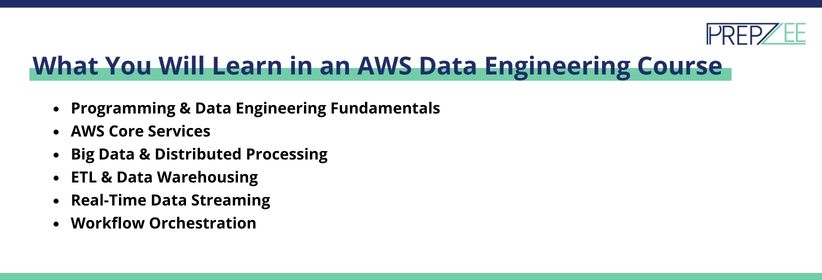
A comprehensive AWS data engineering course follows a structured learning path from fundamentals to advanced cloud data architectures.
Programming & Data Engineering Fundamentals
- Python for data engineering
- Data processing concepts and transformations
- Structured vs unstructured data
- Data lakes vs data warehouses
AWS Core Services
- AWS global infrastructure
- IAM, EC2, S3, VPC, and security fundamentals
- Storage optimization and access control
Big Data & Distributed Processing
- Apache Spark and PySpark
- Working with DataFrames and Spark SQL
- Big data processing using AWS EMR
ETL & Data Warehousing
- AWS Glue for ETL workflows
- Glue Data Catalog and crawlers
- Amazon Redshift for analytics and reporting
Real-Time Data Streaming
- Apache Kafka fundamentals
- AWS MSK
- Amazon Kinesis Streams and Firehose
Workflow Orchestration
- Apache Airflow concepts
- DAGs, operators, and scheduling
- AWS Managed Workflows for Apache Airflow (MWAA)
Hands-On Projects in AWS Data Engineer Full Course
Practical experience is a critical component of any high-quality AWS data engineer full course. Learners work on real-world, industry-relevant projects such as:
- Building scalable ETL pipelines on AWS
- Processing large datasets using Spark and EMR
- Implementing real-time streaming pipelines with Kinesis
- Designing analytics workflows using Redshift
- Orchestrating data pipelines with Apache Airflow
These projects help learners develop job-ready skills and confidently handle real production environments.
Career Opportunities After AWS Data Engineer Certification
After completing AWS data engineer training and earning the AWS Certified Data Engineer – Associate credential, professionals can pursue roles such as:
- AWS Data Engineer
- Cloud Data Engineer
- Big Data Engineer
- Data Platform Engineer
- AWS Analytics Engineer
- AWS Data Architect
Industries including fintech, e-commerce, healthcare, SaaS, and logistics actively hire AWS-certified data engineers.
Why AWS Data Engineering Is a High-Growth Career Path

- Rapid cloud adoption across enterprises
- AWS remains the leading cloud service provider
- Increasing demand for real-time and scalable data solutions
- Strong salary growth for AWS-certified professionals
- Long-term relevance across industries
Choosing the right AWS data engineering course positions you for sustained career growth in the cloud ecosystem.
Final Thoughts
A structured AWS data engineer course, combined with hands-on projects and preparation for the AWS Certified Data Engineer Associate certification, provides the skills and recognition required to succeed in modern data engineering roles. As organizations continue to scale their cloud data platforms, investing in AWS data engineer training is a strategic move toward long-term career success.
FAQ
AWS data engineer training focuses on building and managing data pipelines using AWS services such as S3, Glue, Redshift, EMR, and Kinesis.
This course prepares learners for the AWS Certified Data Engineer – Associate (DEA-C01) certification.
Yes. The certification validates practical AWS data engineering skills and significantly improves job prospects and salary potential.
Software engineers, data analysts, cloud professionals, and freshers with basic programming knowledge can benefit from an AWS data engineering course.
Yes. Professional courses include hands-on projects covering ETL pipelines, streaming data, and analytics workflows.
Most programs range between 8 to 16 weeks, depending on curriculum depth and project coverage.


