





Top AI and Machine Learning Interview Questions


Table of content
Artificial Intelligence (AI) and Machine Learning (ML) continue to dominate the 2026 job market. From fast-growing startups to Fortune 500 companies, organizations across every sector are urgently seeking professionals skilled in data-driven decision-making, predictive modeling, generative AI, and intelligent system design.
Whether you’re gearing up for AI/ML interviews or looking to upskill through structured learning, mastering the most common interview questions—and delivering clear, confident answers—is key to standing out.
This comprehensive guide breaks down essential AI and Machine Learning interview questions, explains them in straightforward terms, and provides structured, industry-ready responses. If you’re currently in an AI and Machine Learning course or aiming for a recognized AI ML certification, this blog will strengthen your foundation and boost your preparation.
Why AI and Machine Learning Skills Matter Today
AI and ML have moved far beyond niche status—they now drive core business functions worldwide. These technologies power personalized recommendation engines, advanced fraud detection, conversational virtual assistants, autonomous systems, predictive maintenance, and generative content creation across industries like tech, finance, healthcare, retail, and automotive.
Employers consistently prioritize candidates with practical, hands-on expertise in:
- Core machine learning algorithms and optimization
- Model evaluation, tuning, and performance metrics
- Deep learning architectures, including transformers and generative models
- Real-world deployment, MLOps, monitoring, and production pipelines
Structured programs such as an AI ML course or AI ML certificate program deliver the theory, hands-on projects, and certification credibility needed to accelerate career growth in this high-demand field.
Core Machine Learning Interview Questions
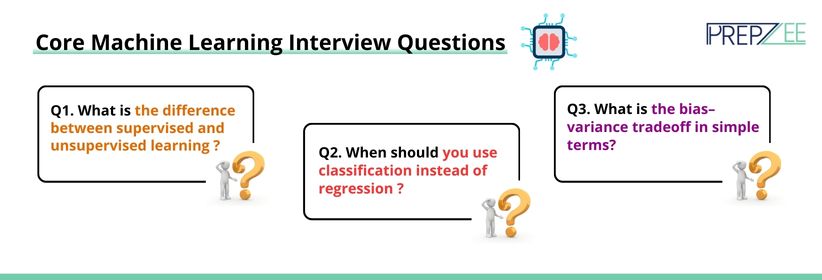
1. What is the difference between supervised and unsupervised learning?
Supervised learning trains models on labeled data, where both inputs and correct outputs are provided. The algorithm learns by minimizing prediction errors against known labels. Typical use cases include classification (e.g., spam detection) and regression (e.g., house price prediction).
Unsupervised learning works with unlabeled data to discover hidden patterns, such as clustering similar customers or dimensionality reduction for visualization/feature engineering.
How to prepare: Use real-world examples and explain when you’d choose one over the other to demonstrate practical insight.
2. When should you use classification instead of regression?
Use classification when the target variable is categorical or belongs to discrete classes (e.g., spam/not spam, disease/no disease, customer churn yes/no).
Use regression when predicting continuous numerical values (e.g., stock prices, temperature forecasts, sales revenue).
Key insight: Focus on the nature of the output—categories/labels mean classification, even if internal probabilities are numeric.
3. What is the bias–variance tradeoff in simple terms?
The bias-variance tradeoff describes the tension between model simplicity and complexity:
- High bias (underfitting): Model is too simplistic and misses underlying patterns.
- High variance (overfitting): Model is too complex and captures noise/noise instead of signal.
The goal is a sweet spot where the model generalizes well to new data. Techniques like regularization, cross-validation, and ensemble methods help achieve balance.
Deep Learning Interview Questions
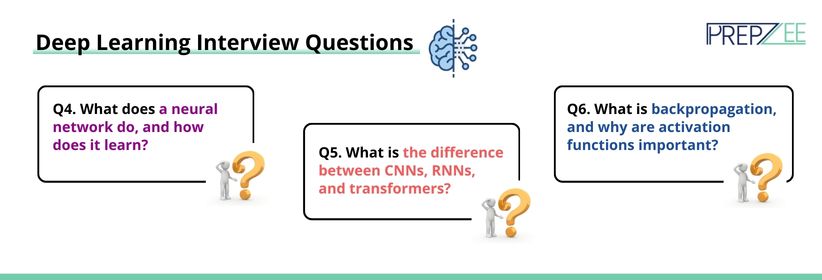
4. What does a neural network do, and how does it learn?
A neural network processes input data through interconnected layers of artificial neurons, applying weights, biases, and activation functions to produce predictions or classifications.
Learning occurs via:
- Forward pass: Generate predictions.
- Loss calculation: Measure error against true values.
- Backward pass (backpropagation): Update weights to minimize loss.
This iterative process continues until performance stabilizes.
5. What is the difference between CNNs, RNNs, and transformers?
- CNNs (Convolutional Neural Networks): Excel at spatial/hierarchical data like images and video (e.g., object detection).
- RNNs (Recurrent Neural Networks): Handle sequential/time-series data (e.g., stock prediction, early language models), but suffer from vanishing gradients.
- Transformers: Rely on self-attention to process entire sequences in parallel, capturing long-range dependencies efficiently—now the foundation of modern NLP, generative AI, and large language models.
Top AI ML courses in 2026 emphasize transformers due to their dominance in GenAI applications.
6. What is backpropagation, and why are activation functions important?
Backpropagation computes gradients of the loss with respect to weights by propagating errors backward from output to input layers, enabling efficient weight updates via gradient descent.
Activation functions (ReLU, sigmoid, tanh, GELU, etc.) add non-linearity, allowing networks to model complex, non-linear relationships. Without them, even deep networks reduce to linear transformations.
Model Evaluation and Metrics Questions
7. What is accuracy, and when is it useful?
Accuracy is the ratio of correct predictions to total predictions.
It is reliable when:
- Classes are balanced
- Misclassification costs are symmetric
In most real-world scenarios (especially imbalanced data), use precision, recall, F1-score, or AUC-ROC instead.
8. What is cross-validation, and why do we use test splits?
Cross-validation (e.g., k-fold) trains and evaluates the model on multiple data partitions to get a robust performance estimate and reduce variance from a single split.
A separate test set (held-out data) simulates unseen production data, providing an unbiased measure of generalization.
9. How do you handle imbalanced datasets?
Effective strategies include:
- Resampling: Oversampling minority (SMOTE) or undersampling majority
- Algorithm-level: Class weights in loss functions
- Better metrics: Precision-recall curve, F1-score, AUC-PR instead of accuracy
Mastering imbalance handling is a core topic in advanced AI machine learning courses.
Practical AI and ML Interview Questions
10. What is model drift?
Model drift happens when model performance degrades over time due to changes in real-world data.
- Data drift: Shift in input feature distribution
- Concept drift: Change in input-output relationship
Proactive monitoring and retraining are critical for production reliability.
11. How do ML pipelines and monitoring work?
ML pipelines automate end-to-end workflows: data ingestion, feature engineering, training, validation, deployment, and serving (often using tools like MLflow, Kubeflow, or cloud services).
Monitoring tracks:
- Model metrics (accuracy, latency, drift)
- Data quality and schema changes
- Anomalies and alerts
This MLOps practice ensures sustained performance in production environments.
How an AI ML Certification Helps You Prepare
Enrolling in a structured AI certificate course or AI ML certificate program equips learners to:
- Master theoretical foundations and latest advancements (e.g., GenAI, transformers)
- Build portfolio-ready hands-on projects
- Practice realistic interview scenarios and coding challenges
- Earn credentials that signal expertise to recruiters
A high-quality AI and Machine Learning course effectively closes the gap between theory and the practical, production-focused skills employers demand in 2026.
Final Thoughts
AI and Machine Learning interviews go beyond rote knowledge—they evaluate your ability to reason, solve ambiguous problems, explain trade-offs, and apply concepts to real systems. With targeted preparation and a solid AI ML course, you’ll handle both theoretical and practical questions with confidence.
If you’re committed to a high-impact, future-proof career, investing in the right AI learning courses and earning a respected AI ML certification remains one of the smartest moves you can make in 2026.
FAQ
AI learning courses are ideal for students, working professionals, engineers, analysts, and anyone looking to build a career in AI and ML, regardless of prior experience.
Yes. An AI ML certification validates your skills, improves job prospects, and demonstrates commitment to continuous learning in a competitive job market.
Basic knowledge of mathematics, statistics, and programming (especially Python) is helpful, but many AI machine learning courses start from fundamentals.
Common roles include Machine Learning Engineer, Data Scientist, AI Engineer, Business Analyst, and Research Associate.
Most AI ML certificate programs range from 3 to 9 months, depending on depth, hands-on projects, and specialization.


