


 Blog Model Context Protocol (MCP): Complete Guide with Architecture, Use Cases & Examples (2026)
 Model Context Protocol (MCP): Complete Guide with Architecture, Use Cases & Examples (2026)

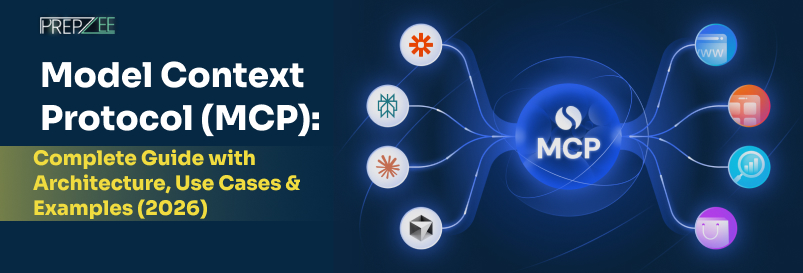
Table of content
- Introduction
- What Is Model Context Protocol (MCP)?
- Why This Approach Matters in 2026
- How It Works (Architecture Explained)
- Core Components
- Model Context Protocol (MCP) vs RAG vs Direct API
- Real-World Use Cases
- Why It Reduces Hallucinations
- How to Start Learning MCP
- Skills and Career Impact
- Future Outlook
- Conclusion
- FAQ
Introduction
Artificial Intelligence has evolved rapidly with the rise of Large Language Models (LLMs), enabling machines to generate human-like responses, assist in development, and automate content workflows. Despite these advancements, a critical limitation still exists—AI systems are largely confined to generating responses rather than performing real-world actions.
Most AI models operate within static environments. They cannot fetch live data, interact with external tools, or execute workflows such as updating records, triggering APIs, or managing business operations. This creates a gap between intelligence and execution.
To address this limitation, a new approach is emerging that focuses on enabling AI systems to interact with external environments in a structured way. The Model Context Protocol introduces a standardized layer that allows AI applications to connect with tools, APIs, and data sources efficiently.
What Is Model Context Protocol (MCP)?
MCP is an open standard designed to help AI systems communicate with external platforms such as databases, APIs, and applications without requiring custom integrations for each connection.
Instead of building separate logic for every tool, this framework provides a unified structure that simplifies communication and improves scalability. It essentially transforms AI from a system that generates answers into one that can execute actions.
At a high level, this approach enables AI systems to:
- Access real-time data from external sources
- Trigger actions such as sending emails or updating systems
- Interact with multiple tools using a single standardized layer
This shift is what makes modern AI systems more practical for real-world use cases.
Why This Approach Matters in 2026

The AI landscape is moving beyond standalone models toward agent-based systems that can handle complex, multi-step tasks. Businesses now expect AI to not only provide insights but also execute workflows and automate operations.
However, traditional approaches introduce several challenges:
- Integrations are repetitive and time-consuming
- Systems become difficult to scale as tools increase
- Maintenance effort grows exponentially
The MCP solves these issues by introducing a standardized communication layer between AI and external systems.
This results in:
- Faster development cycles
- Reduced integration complexity
- Improved system scalability
Ultimately, AI systems become more efficient, reliable, and capable of handling real-world tasks.
How It Works (Architecture Explained)
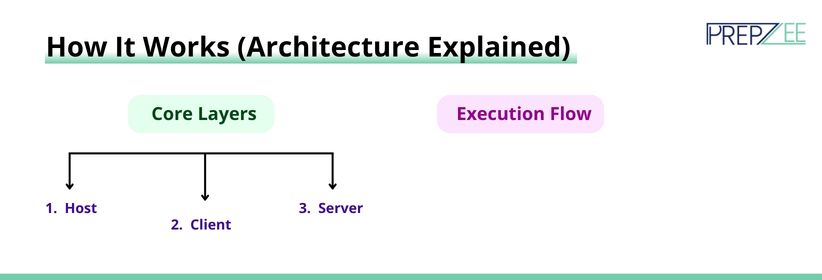
The architecture is built around three core components that work together to enable seamless interaction.
Core Layers
- Host – The AI application where user interaction happens
- Client – The communication layer that connects AI with external systems
- Server – The system that provides tools, APIs, or data
Execution Flow
- A user submits a query
- The AI determines if external data or action is required
- The request is sent through the client
- The server processes the request
- The response is returned to the AI
- The AI generates the final output
This structured flow ensures that AI systems can interact with real-world systems in a scalable and reliable way.
Core Components
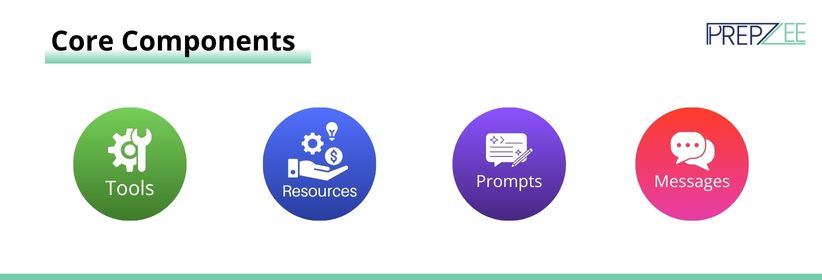
To understand how this framework operates, it’s important to look at its building blocks.
- Tools: Functions that the AI can execute, such as fetching data or triggering actions
- Resources: External data sources like APIs, databases, or files
- Prompts: Structured instructions that guide the AI’s behavior
- Messages: The communication format used to exchange data
These components ensure that interactions remain consistent and predictable across different systems.
Model Context Protocol (MCP) vs RAG vs Direct API
As AI systems evolve, one of the biggest challenges is how they access and use external data. This is where three major approaches come into play:
- Model Context Protocol (MCP)
- Retrieval-Augmented Generation (RAG)
- Direct API Integration
Each of these methods solves a different problem. Understanding their differences is crucial if you want to build scalable, production-ready AI systems.
The MCP focuses on enabling AI to interact with tools and perform actions, while RAG is designed to enhance knowledge retrieval, and direct APIs are used for custom, hardcoded integrations.</
In simple terms:
- RAG helps AI know more
- MCP helps AI do more
- APIs help developers control everything manually
Key Differences: MCP vs RAG vs Direct API
| Parameter | Model Context Protocol (MCP) | Retrieval-Augmented Generation (RAG) | Direct API Integration |
| Core Purpose | Enable AI to use tools & take actions | Improve AI knowledge using external data | Connect systems via custom code |
| Functionality | Structured tool calling via protocol | Retrieves documents & injects into prompt | Manual API request-response |
| Scalability | High (standardized integration) | Medium (depends on vector DB & setup) | Low (each API is custom-built) |
| Maintenance | Low (single protocol for many tools) | Medium (needs data updates & embeddings) | High (constant updates & debugging) |
| Flexibility | Very high (plug-and-play tools) | Limited to data retrieval | Depends on developer effort |
| Real-Time Capability | Yes (live tool execution) | Limited (depends on data freshness) | Yes |
| Development Effort | Moderate (initial setup) | Moderate | High |
| Token Usage | Optimized (structured calls) | High (large context injection) | Low |
| Use Case | AI agents, automation, enterprise tools | Chatbots, Q&A systems, knowledge bases | Backend integrations, microservices |
| Example | AI agent booking meetings via tools | Chatbot answering from PDF/docs | Custom payment API integration |
Real-World Use Cases

This approach is already being applied across industries to build more advanced and capable AI systems.
Common Applications
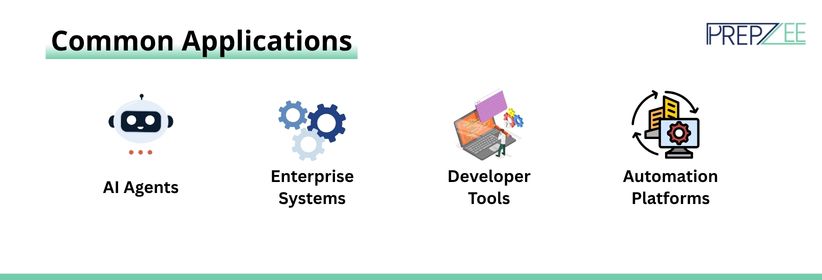
- AI Agents: Automating workflows such as scheduling, emailing, and task management
- Enterprise Systems: Querying databases, generating reports, and analyzing business data
- Developer Tools: Assisting with code execution, debugging, and integrations
- Automation Platforms: Connecting multiple SaaS tools into unified workflows
By eliminating the need for multiple custom integrations, systems become significantly easier to scale and maintain.
Why It Reduces Hallucinations
One of the biggest challenges in AI is the generation of incorrect or misleading information. This happens because models rely on probability rather than verified data.
By enabling direct interaction with external systems, AI can:
- Retrieve real-time, accurate data
- Use trusted tools instead of assumptions
- Generate responses based on verified outputs
This leads to improved accuracy and greater trust in AI-driven systems.
How to Start Learning MCP
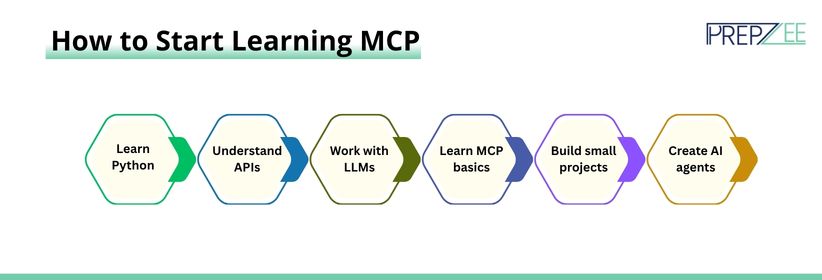
- Learn Python
- Understand APIs
- Work with LLMs
- Learn MCP basics
- Build small projects
- Create AI agents
Skills and Career Impact
As AI systems evolve, the demand for professionals who can build and manage intelligent systems is increasing. Traditional skills such as machine learning and API development remain important, but the ability to integrate AI with real-world systems is becoming equally critical.
Professionals who understand this approach can explore roles such as:
- AI Engineer
- Machine Learning Engineer
- Automation Engineer
- AI Agent Developer
Professionals who already understand Python, APIs, and machine learning can take the next step by applying these skills in real-world projects. Programs like the Generative AI & ML Training Course help bridge the gap between learning concepts and building production-ready AI systems.
Future Outlook

The future of AI lies in systems that can operate independently, make decisions, and execute tasks in real time. As organizations continue to adopt AI at scale, the need for standardized integration frameworks will grow significantly.
The MCP is expected to become a foundational layer in this ecosystem, enabling the development of scalable and reliable AI applications.
Conclusion
Artificial Intelligence is transitioning from a phase of generating responses to executing real-world tasks. While approaches like RAG and APIs have contributed significantly to AI development, they are not sufficient on their own to support the next generation of systems.
By introducing a structured and standardized way for AI to interact with external tools and data, the Model Context Protocol enables a new class of applications that are both intelligent and actionable.
For anyone looking to build or scale AI systems in 2026, understanding this shift is essential.
FAQ
Model Context Protocol (MCP) is an open standard that enables AI systems to connect with external tools, APIs, and data sources using a unified framework, allowing them to perform real-world actions instead of just generating responses.
MCP is important because it bridges the gap between AI intelligence and execution. It allows AI systems to access real-time data, automate workflows, and interact with external systems efficiently.
MCP works through a client-server architecture where the AI (host) sends requests via a client to external systems (servers), which process the request and return results for the AI to generate final outputs.
The core components of MCP include tools (actions AI can perform), resources (external data sources), prompts (instructions), and messages (communication format).
MCP focuses on enabling AI to perform actions and interact with tools, while RAG (Retrieval-Augmented Generation) helps AI retrieve and use external knowledge for better responses.
MCP is more scalable and standardized compared to direct APIs, which require custom integrations. MCP simplifies development by providing a unified communication layer for multiple tools.
MCP is used in AI agents, automation systems, enterprise tools, and developer platforms to perform tasks like scheduling, data retrieval, reporting, and workflow automation.
MCP reduces hallucinations by allowing AI to fetch real-time and verified data from external sources instead of relying only on pre-trained knowledge.
AI engineers, machine learning engineers, automation developers, and anyone building AI-powered applications should learn MCP to create scalable and production-ready systems.
Yes, MCP is considered a key part of the future of AI, as it enables the development of intelligent systems that can take actions, automate workflows, and operate in real-world environments.
Siddharth Sharma