





 Blog Databricks Certified Data Engineer Associate Exam Guide (2026): Study Plan, Topics, and Preparation Tips
 Databricks Certified Data Engineer Associate Exam Guide (2026): Study Plan, Topics, and Preparation Tips

Table of content
- What Is the Databricks Certified Data Engineer Associate Certification?
- Databricks Certified Data Engineer Associate Exam Details
- Exam Domains and Weightage
- Is Databricks Data Engineer Associate Difficult?
- Prerequisites and Recommended Experience
- 4-Week Databricks Study Plan
- Key Concepts You Must Master
- Best Resources for Preparation
- Exam-Day Tips
- Salary and Career Impact
- Conclusion
- FAQ
The Databricks Certified Data Engineer Associate certification is one of the most valuable credentials for professionals working with modern data platforms and lakehouse architectures. As organizations increasingly rely on Apache Spark, Delta Lake, and cloud-native data pipelines, the demand for Databricks-skilled engineers continues to rise. This certification validates your ability to ingest, transform, and govern data while building reliable production workloads using the Databricks Lakehouse Platform. Whether you’re a data engineer, ETL developer, or analytics engineer, earning this certification can strengthen your career profile and demonstrate practical expertise. At PrepZee, we have observed that many candidates spend excessive time memorizing questions while overlooking important areas such as CI/CD, troubleshooting, and workflow orchestration. This guide combines official exam information with practical preparation strategies to help you prepare confidently.
Whether you’re preparing for your first Databricks certification or looking to strengthen your profile, developing strong fundamentals through a data engineering certification training program can make learning Spark, Delta Lake, and modern data pipelines much easier.
What Is the Databricks Certified Data Engineer Associate Certification?
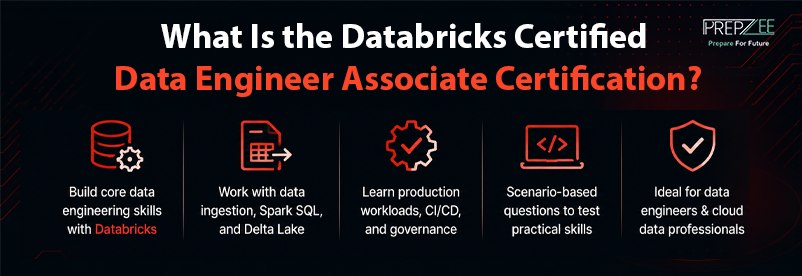
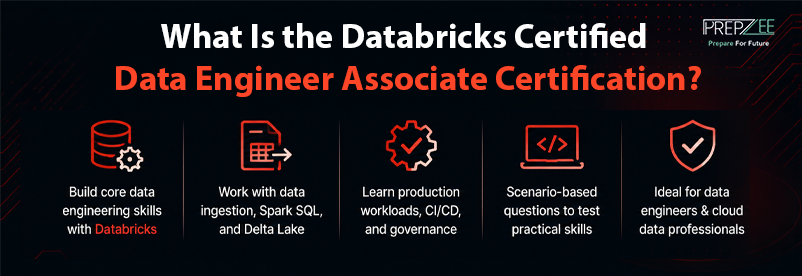
The Databricks Certified Data Engineer Associate certification validates foundational data engineering skills using Databricks technologies. Candidates are expected to understand data ingestion, Spark SQL transformations, Delta Lake fundamentals, production workloads, CI/CD practices, and governance concepts. Unlike purely theoretical certifications, Databricks emphasizes practical understanding through scenario-based questions. Professionals pursuing this certification commonly work as Data Engineers, ETL Developers, Analytics Engineers, Big Data Engineers, and Cloud Data Specialists.
Databricks Certified Data Engineer Associate Exam Details
| Parameter | Details |
| Questions | 45 |
| Duration | 90 Minutes |
| Exam Fee | $200 |
| Delivery Method | Online Proctored |
| Languages | English, Japanese, Portuguese, Korean |
| Certification Validity | 2 Years |
| Passing Score | Not Officially Published |
| Recommended Experience | Around 6 Months |
Databricks uses a criterion-based scoring system and does not publicly disclose a fixed passing score. There are no formal prerequisites, although six months of practical experience is strongly recommended. Candidates should also know that external aids are not allowed during the examination. These details are often overlooked by competitor articles despite being essential for planning exam preparation.
Exam Domains and Weightage
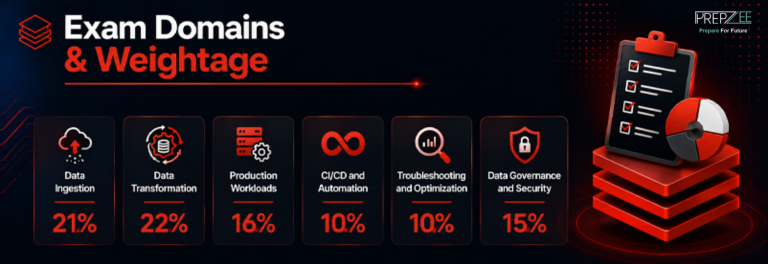
Understanding the domain weightage helps candidates allocate study time efficiently.
| Domain | Weightage |
| Data Ingestion | 21% |
| Data Transformation | 22% |
| Production Workloads | 16% |
| CI/CD and Automation | 10% |
| Troubleshooting and Optimization | 10% |
| Data Governance and Security | 15% |
Data ingestion topics include batch and streaming ingestion, Auto Loader, schema evolution, and COPY INTO operations. Transformation topics focus on Spark SQL, joins, aggregations, Delta Lake features, and performance optimization. Production workloads emphasize Lakeflow Jobs and orchestration. One of the biggest content gaps among competitors is the lack of coverage around CI/CD and troubleshooting topics, even though they represent a significant portion of the exam. Candidates should understand Databricks Repos, Asset Bundles, Git integration, monitoring, and Spark optimization concepts. Governance and security topics focus heavily on Unity Catalog, permissions, and audit capabilities.
Is Databricks Data Engineer Associate Difficult?
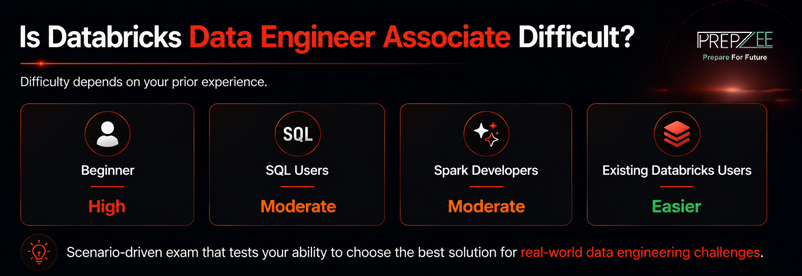
The difficulty of the certification depends largely on prior experience.
| Experience Level | Difficulty |
| Beginner | High |
| SQL Users | Moderate |
| Spark Developers | Moderate |
| Existing Databricks Users | Easier |
Candidates with practical Databricks exposure generally find the exam manageable. Beginners often struggle because the questions are scenario-driven rather than definition-based. The exam evaluates your ability to choose the most appropriate solution for real-world data engineering challenges rather than testing memorization.
Prerequisites and Recommended Experience
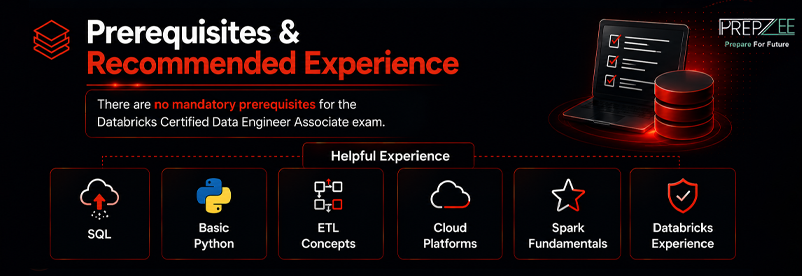
There are no mandatory prerequisites for the Databricks Certified Data Engineer Associate exam. However, candidates with experience in SQL, basic Python, ETL concepts, cloud platforms, and Spark fundamentals usually perform better. Databricks recommends approximately six months of hands-on experience with the platform. Understanding notebooks, clusters, Delta Lake, and data transformations can significantly improve preparation efficiency.
4-Week Databricks Study Plan
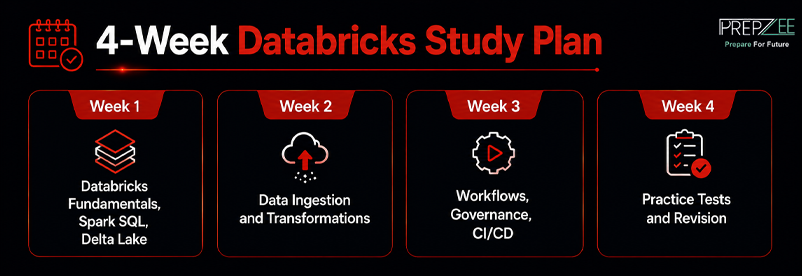
| Week | Focus Area |
| Week 1 | Databricks Fundamentals, Spark SQL, Delta Lake |
| Week 2 | Data Ingestion and Transformations |
| Week 3 | Workflows, Governance, CI/CD |
| Week 4 | Practice Tests and Revision |
During the first week, candidates should focus on Spark SQL, Delta Lake fundamentals, and Lakehouse architecture. Week two should cover ingestion mechanisms, Auto Loader, schema evolution, and transformation operations. Week three should emphasize Lakeflow Jobs, Unity Catalog, Databricks Repos, and Asset Bundles. The final week should focus on revision, practice exams, and strengthening weak areas.
Key Concepts You Must Master
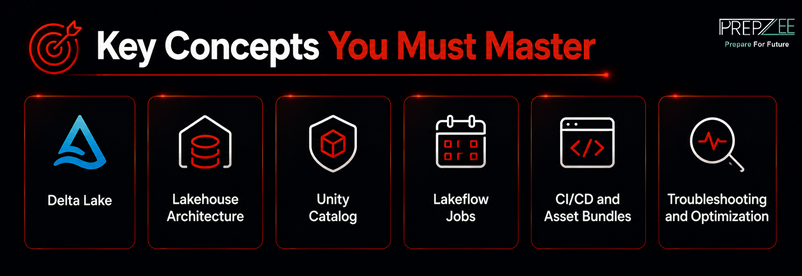
Delta Lake
Delta Lake is one of the most important topics on the exam. Candidates should understand ACID transactions, schema enforcement, time travel, MERGE operations, and version control. These features ensure reliable and scalable data pipelines.
Since many organizations deploy Databricks within Azure environments, understanding broader Azure data engineering skills can help professionals design scalable analytics architectures.
Lakehouse Architecture
The Databricks Lakehouse architecture combines the strengths of data lakes and warehouses. Candidates should understand bronze, silver, and gold layers, as well as the benefits of unified storage and analytics.
Unity Catalog
Unity Catalog provides centralized governance and security. Important concepts include metastores, catalogs, schemas, permissions, row-level security, and audit capabilities. Governance-related questions frequently appear in the exam.
Lakeflow Jobs
Production workloads require understanding task orchestration, scheduling, retries, dependencies, and monitoring. Candidates should know how Lakeflow Jobs help automate production pipelines.
CI/CD and Asset Bundles
This is one of the biggest gaps in competing blogs. Candidates should understand Git integration through Databricks Repos, Asset Bundles, Databricks CLI, and packaging workloads across environments. These concepts are increasingly important in modern DevOps workflows.
Troubleshooting and Optimization
Another commonly overlooked topic involves performance tuning and troubleshooting. Candidates should understand Spark UI, data skew, partitioning, autoscaling, shuffle partitions, and cluster optimization. Many scenario-based questions test these concepts.
Best Resources for Preparation
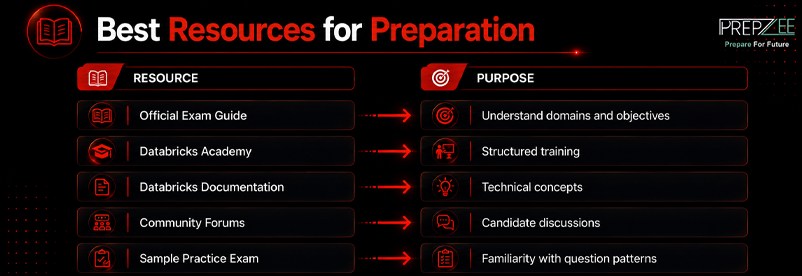
| Resource | Purpose |
| Official Exam Guide | Understand domains and objectives |
| Databricks Academy | Structured training |
| Databricks Documentation | Technical concepts |
| Community Forums | Candidate discussions |
| Sample Practice Exam | Familiarity with question patterns |
At PrepZee, we generally recommend combining official documentation with hands-on practice and mock tests rather than relying solely on dumps. Building practical understanding is often more valuable than memorizing answers.
Exam-Day Tips
On exam day, manage your time carefully. With 45 questions in 90 minutes, candidates have approximately two minutes per question. Read scenarios carefully, eliminate obviously incorrect answers, and flag difficult questions for review. Most questions focus on selecting the best approach rather than writing code from scratch. Staying calm and focusing on keywords can improve accuracy.
Salary and Career Impact
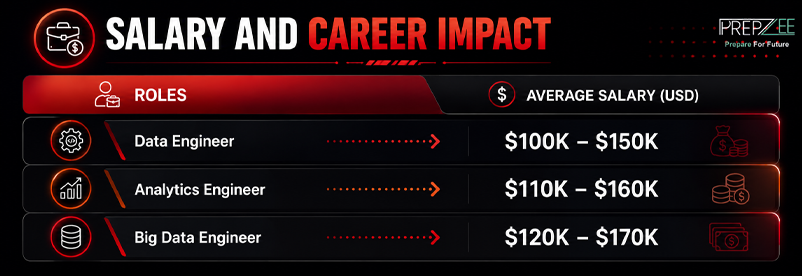
The Databricks Certified Data Engineer Associate certification can open opportunities across technology, finance, healthcare, and retail sectors.
| Role | Average Salary |
| Data Engineer | $100K–$150K |
| Analytics Engineer | $110K–$160K |
| Big Data Engineer | $120K–$170K |
Certified professionals often benefit from stronger career prospects and higher earning potential. Organizations increasingly seek engineers with expertise in Spark, Delta Lake, and cloud-native architectures.
Conclusion
The Databricks Certified Data Engineer Associate certification is more than just an exam—it validates practical skills required in modern data engineering environments. Success requires a combination of theoretical understanding, hands-on experience, and structured revision. By focusing on official exam domains, mastering Delta Lake and Unity Catalog concepts, and understanding CI/CD and optimization techniques, candidates can approach the exam with confidence. At PrepZee, we believe that combining real-world practice with consistent study is the most effective way to succeed and build long-term expertise in data engineering.
As modern analytics platforms continue to evolve, expanding your understanding of emerging technologies and Microsoft Fabric data engineering concepts can further strengthen your long-term career prospects.
Frequently Asked Questions
FAQ
Databricks does not officially publish a fixed passing score. Candidates should focus on mastering concepts rather than targeting a specific percentage.
The exam can be challenging for beginners, but candidates with practical experience generally find it manageable.
Basic knowledge of SQL and Python is helpful, although extensive coding expertise is not mandatory.
Most candidates can prepare in four to eight weeks depending on their experience level.
Yes. Demand for Databricks professionals continues to grow, making the certification valuable for career advancement.
Yes, candidates with SQL and Spark experience can often prepare successfully within four weeks.
No. Practice exams should complement hands-on experience and official documentation rather than replace them.
Siddharth Sharma