






AI Engineer vs Data Engineer: Key Differences, Skills, Salaries, and Career Paths in 2026

Table of content
Artificial intelligence and big data are transforming how businesses build products, automate workflows, and extract insights. As companies increasingly invest in AI and data-driven applications, demand for AI Engineers and Data Engineers has grown significantly. While these roles often collaborate and share technologies like Python and cloud platforms, their objectives are fundamentally different.
A Data Engineer focuses on building the infrastructure that powers analytics and machine learning systems. AI Engineers, on the other hand, are responsible for turning machine learning models into intelligent products that users interact with. Understanding the distinction between these roles is essential for professionals planning their careers and organizations building AI teams.
AI Engineer vs Data Engineer: Quick Comparison
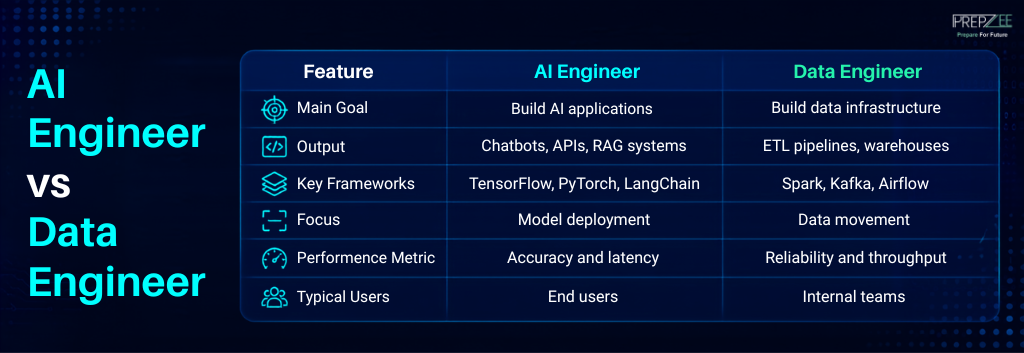
| Feature | AI Engineer | Data Engineer |
| Main Goal | Build AI applications | Build data infrastructure |
| Output | Chatbots, APIs, RAG systems | ETL pipelines, warehouses |
| Key Frameworks | TensorFlow, PyTorch, LangChain | Spark, Kafka, Airflow |
| Focus | Model deployment | Data movement |
| Performance Metric | Accuracy and latency | Reliability and throughput |
| Typical Users | End users | Internal teams |
Although both roles work with data, the way they create value is entirely different.
What Does a Data Engineer Do?
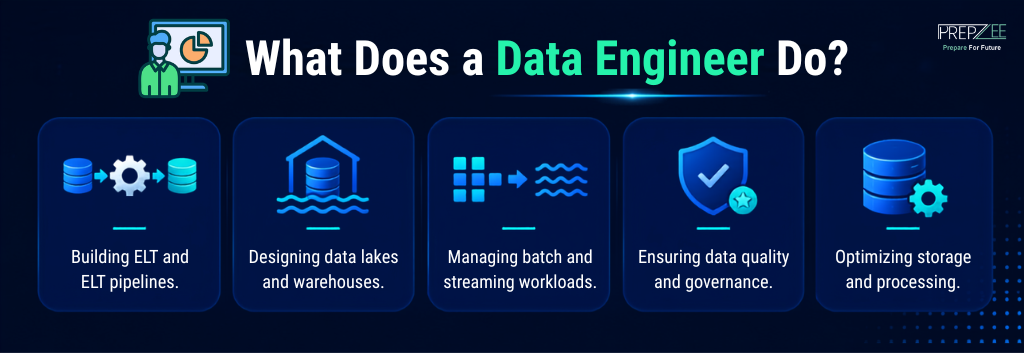
Data Engineers are responsible for designing, building, and maintaining systems that allow organizations to collect, process, and store massive amounts of information. Their work ensures that data reaches analysts, dashboards, and AI systems in a reliable and scalable manner.
Think of Data Engineers as the architects behind modern data ecosystems. Without them, AI applications would struggle to access clean and structured data.
Common Responsibilities
- Building ETL and ELT pipelines.
- Designing data lakes and warehouses.
- Managing batch and streaming workloads.
- Ensuring data quality and governance.
- Optimizing storage and processing.
Popular Technologies
| Category | Tools |
| Processing | Apache Spark, Databricks |
| Streaming | Kafka, Flink |
| Orchestration | Airflow |
| Storage | Snowflake, Redshift |
| Languages | SQL, Python, Scala |
Modern Data Engineers are increasingly expected to understand DataOps, streaming architectures, and cloud-native platforms.
Professionals looking to strengthen their understanding of ETL pipelines, Spark, and cloud data platforms often start with a structured data engineer program before specializing further.
What Does an AI Engineer Do?
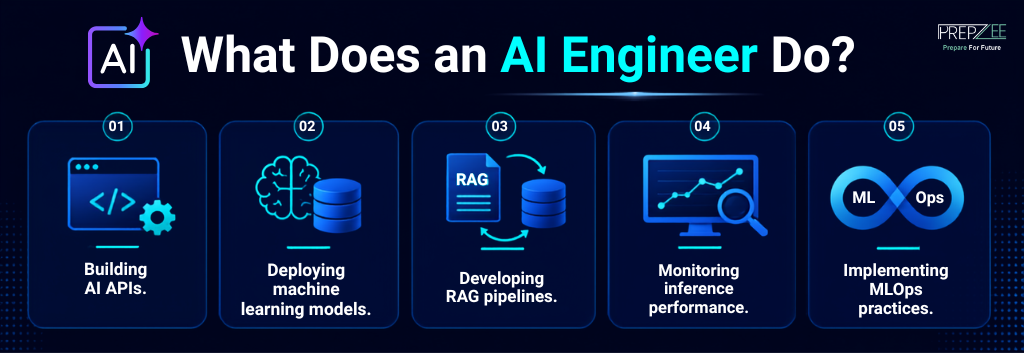
AI Engineers focus on deploying and scaling machine learning models. Their work begins after the experimentation phase and involves converting models into production-ready applications.
As generative AI adoption grows, AI Engineers are becoming critical to building chatbots, recommendation engines, autonomous agents, and intelligent search systems.
Typical Responsibilities
- Building AI APIs.
- Deploying machine learning models.
- Developing RAG pipelines.
- Monitoring inference performance.
- Implementing MLOps practices.
Popular Technologies
| Category | Tools |
| Frameworks | PyTorch, TensorFlow |
| LLM Tools | Hugging Face, LangChain |
| Deployment | Docker, Kubernetes |
| MLOps | MLflow |
| Cloud Platforms | Azure AI, SageMaker |
Unlike Data Engineers, AI Engineers spend more time optimizing model behavior, latency, and user experience.
As generative AI and agentic systems become mainstream, developing hands-on experience through Ai And Machine Learning Course can help professionals understand model deployment, RAG pipelines, and modern AI frameworks.
Key Differences Between AI Engineers and Data Engineers
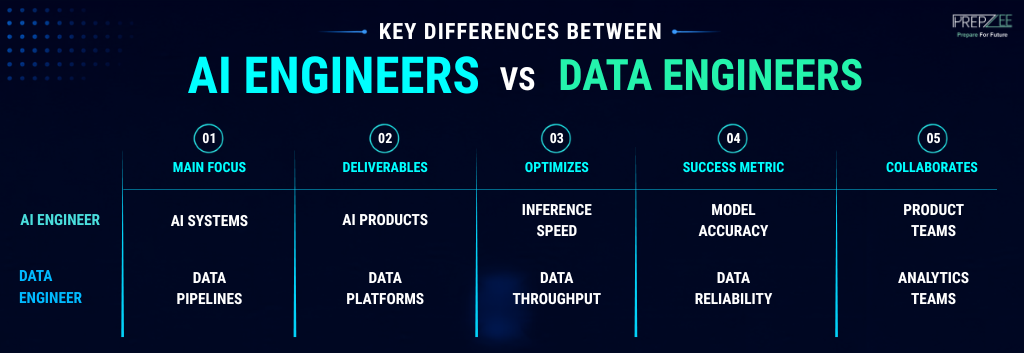
Although both roles overlap, their priorities differ considerably.
| Area | Data Engineer | AI Engineer |
| Main Focus | Data pipelines | AI systems |
| Deliverables | Warehouses and lakes | AI products |
| Optimization | Throughput | Inference speed |
| Success Metric | Data reliability | Model accuracy |
| Collaboration | Analytics teams | Product teams |
In simple terms, Data Engineers provide the fuel, while AI Engineers build the engine.
How These Roles Work Together
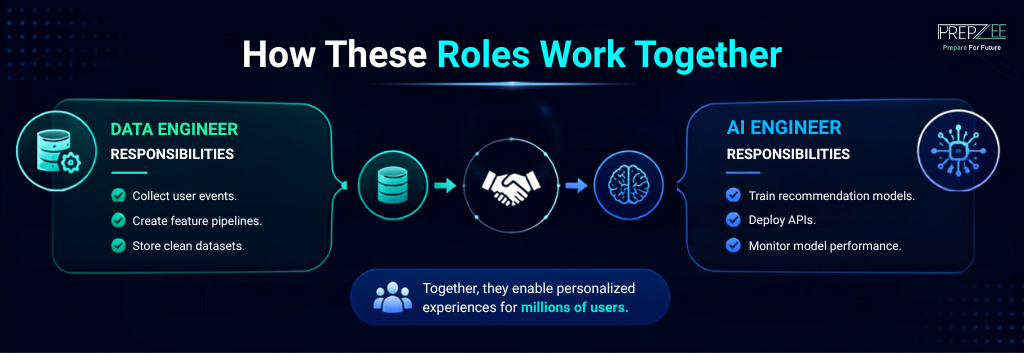
Modern AI systems require both roles.
Consider an e-commerce recommendation engine.
Data Engineer Responsibilities
- Collect user events.
- Create feature pipelines.
- Store clean datasets.
AI Engineer Responsibilities
- Train recommendation models.
- Deploy APIs.
- Monitor model performance.
Together, they enable personalized experiences for millions of users.
This collaboration has given rise to:
- DataOps
- MLOps
- LLMOps
- Feature Stores
- Real-time inference systems
Skills Required in 2026
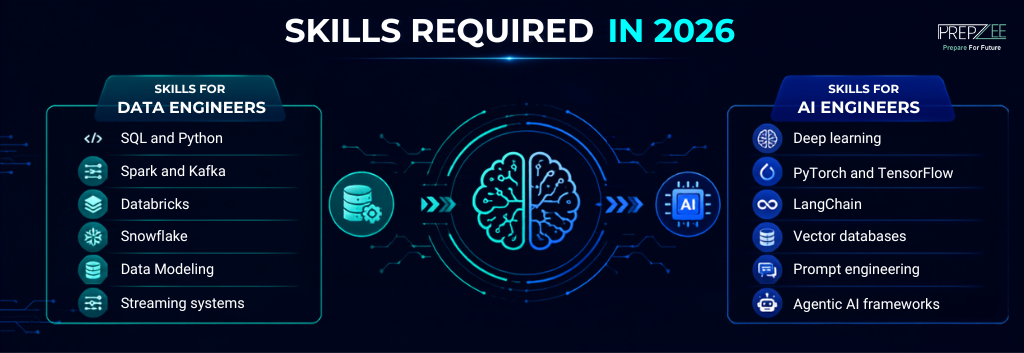
Technology is evolving rapidly, and both careers are changing with it.
Skills for Data Engineers
- SQL and Python
- Spark and Kafka
- Databricks
- Snowflake
- Data Modeling
- Streaming systems
Skills for AI Engineers
- Deep learning
- PyTorch and TensorFlow
- LangChain
- Vector databases
- Prompt engineering
- Agentic AI frameworks
The rise of Generative AI has significantly expanded the scope of AI engineering. Since many organizations deploy analytics workloads on Azure, understanding Azure data engineering skills can provide a strong foundation for building scalable AI and analytics solutions.
Salary Comparison
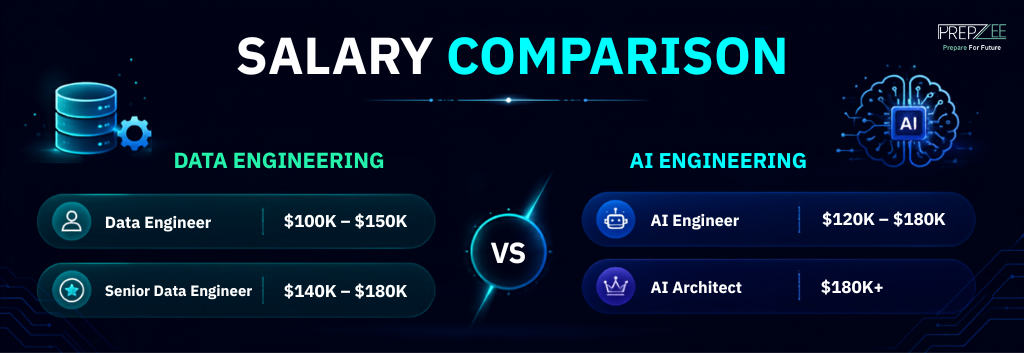
Both careers offer excellent compensation.
| Role | Average Salary |
| Data Engineer | $100K–$150K |
| Senior Data Engineer | $140K–$180K |
| AI Engineer | $120K–$180K |
| AI Architect | $180K+ |
Industries actively hiring these professionals include:
- Healthcare
- Retail
- Finance
- Technology
- SaaS
Which Career Should You Choose?
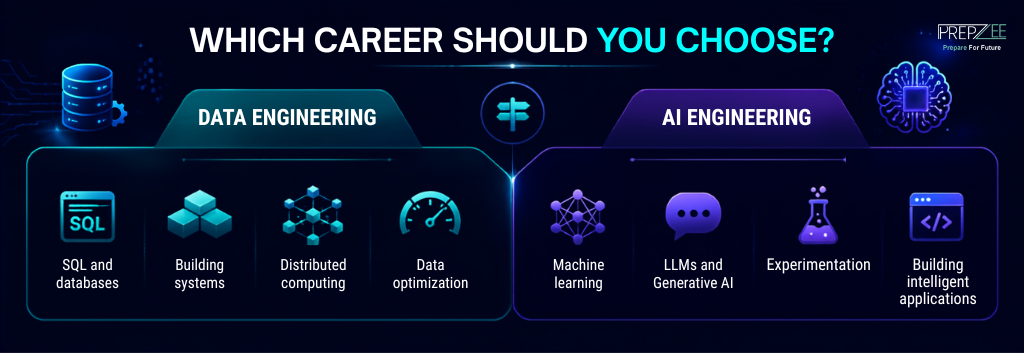
Choose Data Engineering if you enjoy:
- SQL and databases.
- Building systems.
- Distributed computing.
- Data optimization.
Choose AI Engineering if you enjoy:
- Machine learning.
- LLMs and Generative AI.
- Experimentation.
- Building intelligent applications.
Final Thoughts
The debate around AI Engineer vs Data Engineer isn’t about which role is better. Instead, it’s about understanding how these careers complement each other. Data Engineers build the foundation that powers modern analytics and AI systems, while AI Engineers transform that data into intelligent experiences.
As generative AI, agentic systems, and real-time analytics continue to evolve, both careers are expected to remain among the most valuable and fastest-growing roles in technology.
Frequently Asked Questions
FAQ
A Data Engineer focuses on building and maintaining data pipelines, warehouses, and infrastructure that ensure reliable data flow. An AI Engineer uses that data to develop, deploy, and optimize machine learning and AI-powered applications such as chatbots, recommendation engines, and RAG systems.
Both careers offer competitive salaries. However, AI Engineers often command slightly higher salaries because of the growing demand for generative AI, LLMs, and machine learning expertise. Compensation varies depending on experience, location, and industry.
Neither role is inherently harder, but they require different skill sets. Data Engineering emphasizes distributed systems, databases, and data pipelines, while AI Engineering focuses on machine learning, deep learning, and model deployment. Your background and interests largely determine which path feels easier.
Yes. Many professionals transition from Data Engineering to AI Engineering because they already possess strong Python, SQL, and cloud computing skills. Learning machine learning frameworks, MLOps, and generative AI concepts can make the transition smoother.
Both careers have strong growth potential. Data Engineers are essential for managing large-scale data systems, while AI Engineers are benefiting from the rapid adoption of generative AI, autonomous agents, and intelligent applications. Demand for both roles is expected to remain high in the coming years.
AI Engineers typically need expertise in Python, machine learning frameworks such as PyTorch and TensorFlow, LLM frameworks like LangChain, vector databases, MLOps, Docker, Kubernetes, and cloud AI services.
Data Engineers commonly work with SQL, Python, Apache Spark, Kafka, Airflow, Snowflake, Databricks, and cloud platforms such as AWS, Azure, and Google Cloud. Knowledge of data modeling and ETL pipelines is also important.
Yes. Data Engineers provide clean and reliable datasets, while AI Engineers use that data to train and deploy AI systems. Modern AI projects often involve close collaboration between DataOps, MLOps, and product teams.
If you enjoy databases, system design, and data infrastructure, Data Engineering may be a better fit. If you’re interested in machine learning, generative AI, and intelligent applications, AI Engineering could be the ideal career path. Both roles offer excellent long-term opportunities.
Artificial intelligence is changing how these roles operate, but it is unlikely to replace them entirely. Instead, AI tools are automating repetitive tasks and helping professionals become more productive. Human expertise in designing data systems, deploying models, and solving complex problems will continue to remain valuable.
Siddharth Sharma