


Azure vs AWS for Data Engineering: Which Should You Learn in 2026?

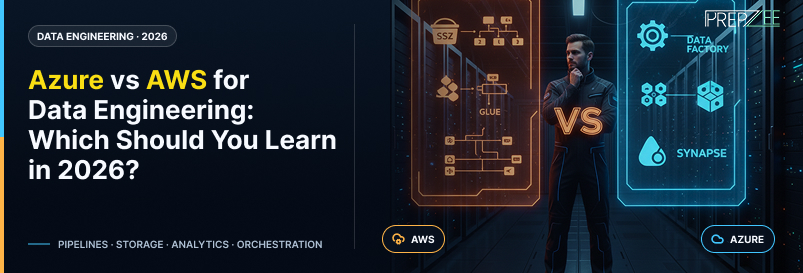
Table of content
- <b>Azure vs AWS for Data Engineering: Key Differences</b>
- <b>What Should You Learn in Azure Data Engineering?</b>
- <b>What Should You Learn in AWS Data Engineering?</b>
- <b>Azure vs AWS: Which Skills Transfer Between Platforms?</b>
- <b>Azure vs AWS: Which Is More Cost-Effective for Data Engineering?</b>
- <b>Which Cloud Platform Should You Learn Based on Your Background?</b>
- <b>Azure vs AWS Certifications for Data Engineers in 2026</b>
- <b>Build the Same Data Engineering Project on Both Platforms</b>
- <b>Final Takeaway</b>
- FAQ
Choosing between Microsoft Azure and Amazon Web Services (AWS) can be confusing when you are starting a Data Engineering career. Both platforms offer cloud storage, data pipelines, distributed processing, and analytics services, but their tools and learning paths differ.
Should you learn Azure Data Factory and Microsoft Fabric, or focus on AWS Glue, Amazon S3, and Redshift?
The right starting platform depends on your existing skills, target employers, and the data engineering projects you want to build.
This guide compares Azure vs AWS specifically for Data Engineering in 2026, including services, skills, costs, certifications, and practical projects to help you choose a learning path.
Azure vs AWS for Data Engineering: Key Differences
Microsoft Azure and AWS can both support complete data engineering workflows, from data ingestion to analytics.
However, their services are organized differently.
Azure offers data engineering services alongside Microsoft Fabric, a unified analytics platform combining data integration, lakehouses, warehousing, and business intelligence.
AWS provides services such as S3, Glue, Athena, and Redshift that can be combined into a data pipeline according to workload requirements.
| Comparison | Microsoft Azure | AWS |
| Cloud storage | Azure Data Lake Storage | Amazon S3 |
| Data integration | Azure Data Factory | AWS Glue |
| Data warehouse | Fabric Warehouse, Azure Synapse | Amazon Redshift |
| Distributed processing | Azure Databricks, Fabric Spark | Amazon EMR, AWS Glue |
| SQL analytics | Fabric Warehouse, Synapse | Amazon Athena, Redshift |
| Orchestration | Azure Data Factory, Fabric Pipelines | Step Functions, Glue Workflows |
| Primary ecosystem | Microsoft and Azure services | AWS services |
These are comparable capabilities, not exact one-to-one replacements. Their architectures, pricing, and operating models differ.
What Should You Learn in Azure Data Engineering?
Azure is relevant for professionals targeting organizations that use Microsoft’s cloud infrastructure and analytics ecosystem.
A practical Azure learning path should include the following services.
1. Azure Data Lake Storage
Learn how to store structured and unstructured data, organize storage folders, manage access, and support analytical workloads.
2. Azure Data Factory
Azure Data Factory helps create and orchestrate data integration workflows.
Learn pipelines, connectors, scheduling, incremental loading, monitoring, and error handling.
3. Azure Databricks
Databricks supports Spark-based data processing and lakehouse development.
Focus on PySpark transformations, Delta tables, performance optimization, and pipeline development.
4. Microsoft Fabric
Microsoft Fabric brings data engineering, warehousing, and analytics experiences into one platform.
Its Data Factory experience includes pipelines and Dataflow Gen2, while its data engineering capabilities support lakehouses and Spark processing.
Fabric and Azure Data Factory are distinct products with different capabilities, so learn their differences rather than treating them as identical.
If you want a platform-specific learning sequence, explore Prepzee’s Azure Data Engineer Career Roadmap .
What Should You Learn in AWS Data Engineering?
AWS provides a range of data services that engineers can combine to build pipelines.
Focus on these core tools.
1. Amazon S3
S3 is commonly used for storing raw and processed data.
Learn storage organization, permissions, file formats, partitioning, and lifecycle management.
2. AWS Glue
Glue supports data integration and ETL processing.
Learn how to create ETL jobs, work with the Glue Data Catalog, handle schema changes, and perform incremental transformations.
3. Amazon Redshift
Redshift is a cloud data warehouse.
Understand data loading, SQL transformations, warehouse design, and query optimization.
4. Amazon Athena
Athena allows engineers to run SQL queries directly against data stored in S3 without first loading it into a separate warehouse.
This is useful for exploring lake data and performing SQL analytics.
5. AWS Step Functions and Amazon EMR
Step Functions can coordinate multi-step processing workflows, while EMR supports workloads using frameworks such as Apache Spark.
You do not need to master every AWS service immediately. Begin with S3, Glue, and SQL analytics before introducing additional components.
Azure vs AWS: Which Skills Transfer Between Platforms?
One important consideration is that learning Azure does not mean starting from zero if you later move to AWS.
Core data engineering concepts remain relevant across both ecosystems.
| Transferable Skill | Azure Application | AWS Application |
| Data ingestion | Data Factory pipelines | Glue integration |
| Data storage | Data Lake Storage | S3 |
| SQL | Fabric Warehouse | Redshift or Athena |
| Spark | Azure Databricks | EMR or Glue |
| Orchestration | Data Factory | Step Functions |
| Security | Azure RBAC and managed identities | AWS IAM |
For example, understanding incremental loading helps whether your pipeline uses Azure Data Factory or AWS Glue.
Similarly, SQL, Python, PySpark, data modeling, and data quality principles remain useful across platforms.
For broader preparation before choosing a cloud provider, read Prepzee’s Data Engineer Roadmap for 2026 .
Azure vs AWS: Which Is More Cost-Effective for Data Engineering?
Neither platform is universally cheaper.
Costs depend on storage volume, processing time, service configuration, data transfer, workload frequency, and region.
For example, AWS Glue ETL jobs and Redshift have different pricing components, while Microsoft Fabric uses a capacity-based model for its integrated workloads.
When comparing project costs, consider:
- Storage and data retention.
- Compute capacity and processing duration.
- Pipeline execution frequency.
- Data transfer and networking.
- Monitoring and additional services.
Use the official AWS Pricing Calculator and Azure Pricing Calculator to estimate costs for the same workload.
For beginners, set billing alerts and use available trials or free-tier resources carefully. Free access does not necessarily cover every service or usage scenario.
Which Cloud Platform Should You Learn Based on Your Background?
Your existing experience can help narrow the decision.
| Your Background or Goal | Learning Direction |
| Power BI and SQL Server experience | Explore Azure and Microsoft Fabric |
| Existing AWS experience | Extend into AWS Data Engineering |
| Azure-based employer | Focus on its Azure data stack |
| AWS-based employer | Learn its AWS data services |
| Complete beginner | Check target job descriptions before choosing |
| Interested in multi-cloud roles | Master one platform, then map equivalent concepts |
For example, a Data Analyst already using Power BI and SQL Server may find Microsoft Fabric familiar because it integrates data engineering and analytics capabilities.
However, an engineer working with S3 and AWS infrastructure may have a more direct learning path into Glue and Redshift.
The most useful starting point is the technology your target role actually requires-not a general claim that one cloud provider is superior.
Azure vs AWS Certifications for Data Engineers in 2026
Certifications can provide structured learning, although they do not replace project experience.
Microsoft Fabric Data Engineer Associate – DP-700
The DP-700 certification focuses on implementing, managing, securing, monitoring, and optimizing data engineering solutions in Microsoft Fabric.
Prepzee’s DP-700 Certification Guide explains the relevant Fabric concepts and preparation areas.
Important: Microsoft’s previous Azure Data Engineer exam, DP-203, retired on March 31, 2025. It should not be presented as an available certification exam in 2026.
AWS Certified Data Engineer – Associate
The AWS Certified Data Engineer – Associate (DEA-C01) evaluates skills involving data ingestion, transformation, pipeline orchestration, storage, monitoring, security, and performance optimization.
Choose certification preparation according to the platform you intend to use, and verify the latest exam objectives on the provider’s official website.
Build the Same Data Engineering Project on Both Platforms
One practical way to understand the differences is to design the same project using each ecosystem.
Project: Automated E-Commerce Sales Pipeline
Imagine a retailer collecting transactions from an API and inventory information from CSV files.
Your project should extract the data, validate it, remove duplicates, transform records, and deliver reporting-ready tables.
| Project Stage | Azure Approach | AWS Approach |
| Store raw data | Azure Data Lake Storage | Amazon S3 |
| Ingest and transform | Azure Data Factory or Databricks | AWS Glue |
| Store analytics data | Fabric Warehouse | Redshift |
| Query results | Warehouse SQL | Redshift SQL or Athena |
| Monitor workflows | Data Factory monitoring | Glue and CloudWatch |
Start by completing the project on one platform. Then recreate the architecture on the other, documenting differences in configuration, monitoring, access control, and cost.
An equivalent architecture does not need identical services.
This exercise demonstrates deeper cloud knowledge than memorizing service names.
Final Takeaway
Azure and AWS both provide the services required to build modern data engineering solutions.
Azure offers integration with Microsoft technologies and Fabric, while AWS offers a range of services that can be combined into different pipeline architectures.
For career preparation, focus on your target employers, strengthen SQL and Python, and complete one production-style cloud project.
Learn one platform thoroughly, understand the underlying engineering concepts, and expand into the second platform when your career or project requirements justify it.
Frequently Asked Questions
FAQ
The learning curve depends on existing experience. Someone familiar with Microsoft tools may find Azure and Fabric easier to approach, while an AWS user may find S3, Glue, and Redshift more familiar.
Demand varies by country, employer, industry, and technology stack. Review current job postings in your target location rather than relying on global cloud market share.
Beginners should generally develop practical experience with one platform first. Once you understand storage, ETL, orchestration, security, and monitoring, learning the corresponding services on another platform becomes easier.
No. Fabric Data Factory and Azure Data Factory are separate offerings. Microsoft provides comparison and migration guidance, but their features and integration experiences differ.
Yes. SQL and Python are useful foundations for both platforms, particularly for transformations, automation, integration, and pipeline troubleshooting.
No. Certifications can demonstrate knowledge, but employers may also assess SQL, Python, architecture, debugging, and experience building reliable pipelines.
Siddharth Sharma