


AI-102 vs AI-103: What’s Changed in Microsoft’s Azure AI Certification?

Table of content
Microsoft has officially announced the transition from AI-102: Azure AI Engineer Associate to AI-103: Azure AI Apps and Agents Developer Associate, marking one of the biggest updates to its Azure AI certification roadmap in recent years. This isn’t simply a new exam code,it reflects how AI development has evolved.
While AI-102 focused on implementing Azure Cognitive Services and traditional AI workloads, AI-103 shifts toward building AI-powered applications, intelligent agents, Retrieval-Augmented Generation (RAG), and solutions using Microsoft Foundry. These changes align with the growing demand for enterprise AI applications powered by large language models (LLMs).
If you’re preparing for an Azure AI certification, understanding these differences is essential. In this guide, we’ll compare AI-102 and AI-103, explore the biggest changes, and help you decide which certification is right for you.
Why Is Microsoft Replacing AI-102?
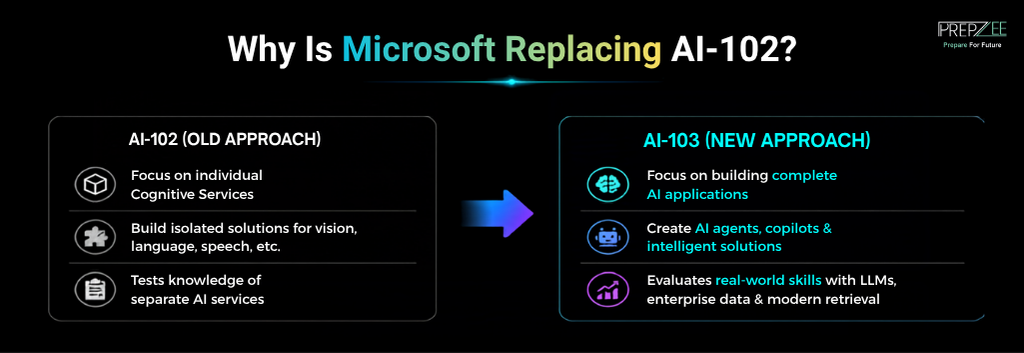
The AI landscape has changed significantly over the past two years. Organizations are no longer deploying isolated AI services for vision, language, or speech—they’re building intelligent assistants, AI copilots, and autonomous agents that combine multiple AI capabilities into a single application.
To reflect these industry changes, Microsoft redesigned its certification around Microsoft Foundry, its unified platform for developing, deploying, and managing AI solutions.
Instead of testing candidates on individual Cognitive Services, AI-103 evaluates how well developers can create complete AI applications that use LLMs, AI agents, enterprise data, and modern retrieval techniques. This makes the certification far more aligned with real-world Azure AI development.
AI-102 vs AI-103: Quick Comparison
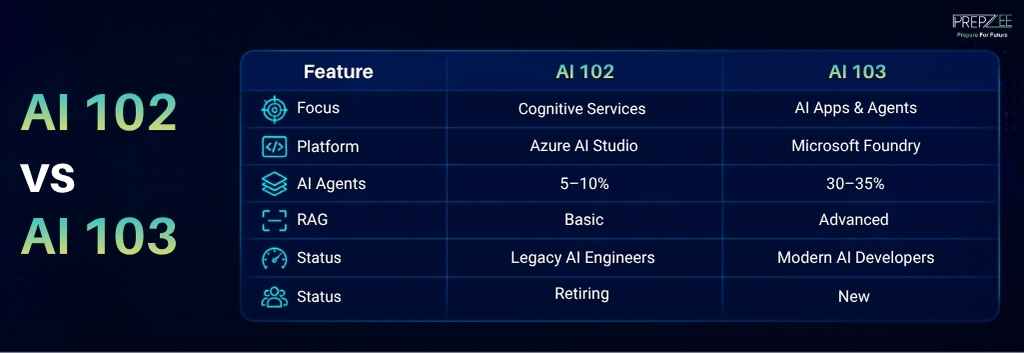
| Feature | AI-102 | AI-103 |
| Certification | Azure AI Engineer Associate | Azure AI Apps and Agents Developer Associate |
| Current Status | Retiring | New Certification |
| Primary Focus | Azure Cognitive Services | AI Apps and Intelligent Agents |
| Platform | Azure AI Studio | Microsoft Foundry |
| Largest Exam Domain | Plan and Manage an Azure AI Solution | Generative AI and Agentic Solutions |
| AI Agents | 5–10% | 30–35% combined with Generative AI |
| RAG | Basic implementation | Advanced implementation across multiple domains |
| New Services | Azure OpenAI | Content Understanding, Foundry Tools, and Agent Service |
| Duration | 100 minutes | 120 minutes |
| Best For | Legacy Azure AI Engineers | Modern AI Developers |
The biggest takeaway is that AI-102 taught you how to integrate AI services, while AI-103 teaches you how to build production-ready AI applications.
The 7 Biggest Changes in AI-103
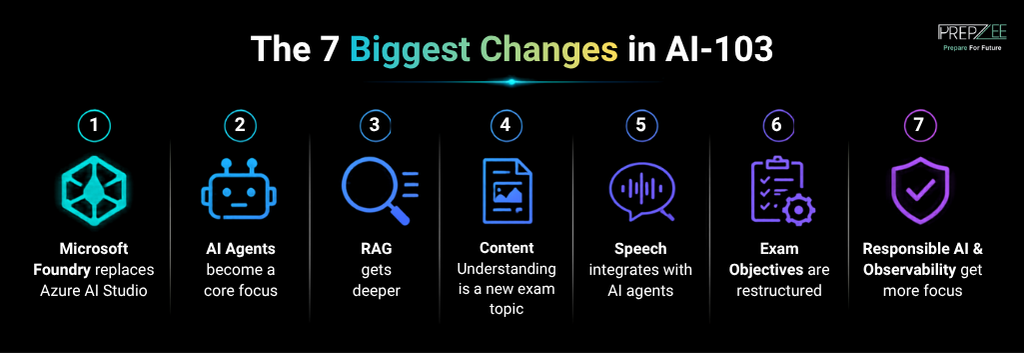
1. Microsoft Foundry Replaces Azure AI Studio
One of the most noticeable changes is Microsoft’s move to Microsoft Foundry, which becomes the central platform for AI application development.
Instead of working across multiple Azure AI services independently, developers now build, deploy, monitor, and manage AI solutions from a unified environment. Candidates are expected to understand project management, deployments, governance, monitoring, and Responsible AI within Foundry.
This shift mirrors how enterprises now develop AI applications at scale.
2. AI Agents Become the Core of the Certification
AI-102 briefly introduced agentic AI as a small objective. AI-103 makes it the centerpiece of the certification.
Candidates are now expected to understand:
- AI agent design.
- Multi-agent orchestration.
- Tool integration.
- Prompt-based workflows.
- Agent memory.
- Autonomous task execution.
This reflects the growing adoption of AI assistants and enterprise copilots across industries.
Unlike previous certifications that focused mainly on calling APIs, AI-103 evaluates your ability to build intelligent systems capable of reasoning and completing complex tasks.
3. Retrieval-Augmented Generation (RAG) Gets Much Deeper
RAG was mentioned in AI-102 as part of generative AI. In AI-103, it is a foundational skill.
Instead of simply understanding the concept, you’ll need to know how to:
- Build retrieval pipelines.
- Configure Azure AI Search.
- Implement vector search.
- Use semantic search.
- Connect enterprise knowledge bases.
- Improve LLM responses using external documents.
For example, an exam scenario might require building an AI support assistant that retrieves information from company documents before generating accurate responses.
This practical approach makes AI-103 much closer to real enterprise AI development.
4. Azure AI Content Understanding Is a New Exam Topic
Azure AI Content Understanding enables developers to process and understand multimodal content, including images, videos, and documents. It extracts structured information that can be used for intelligent document processing, knowledge retrieval, media analysis, and AI-powered automation.
As organizations increasingly adopt multimodal AI solutions, learning this service will help you develop practical Azure AI skills that are valuable for both the AI-103 certification and real-world application development.
5. Speech Is No Longer a Standalone Service
In AI-102, Speech Services belonged to the Natural Language Processing domain.
AI-103 integrates speech into AI agent workflows.
Instead of simply converting speech to text, developers must understand how speech interacts with conversational agents, voice assistants, and multimodal AI applications.
This change reflects how modern AI systems combine text, voice, vision, and reasoning into a single user experience.
6. Exam Objectives Have Been Restructured
Microsoft simplified the certification blueprint by merging related domains.
AI-102 covered six separate skill areas. AI-103 now evaluates five broader domains:
- Plan and Manage Azure AI Solutions.
- Implement Generative AI and Agentic Solutions.
- Implement Computer Vision Solutions.
- Implement Text Analysis Solutions.
- Implement Information Extraction Solutions.
The largest weighting now belongs to Generative AI and Agentic Solutions at 30–35%, clearly showing Microsoft’s emphasis on modern AI development over traditional Cognitive Services.
7. Greater Focus on Responsible AI and Observability
Responsible AI remains important, but Microsoft now expects developers to configure it rather than simply understand it conceptually.
Candidates should know how to:
- Configure safety filters.
- Apply governance policies.
- Monitor AI applications.
- Trace prompts and responses.
- Implement observability for AI systems.
These operational skills better reflect how AI applications are managed in production environments today.
What Topics Have Been Removed or Reduced?
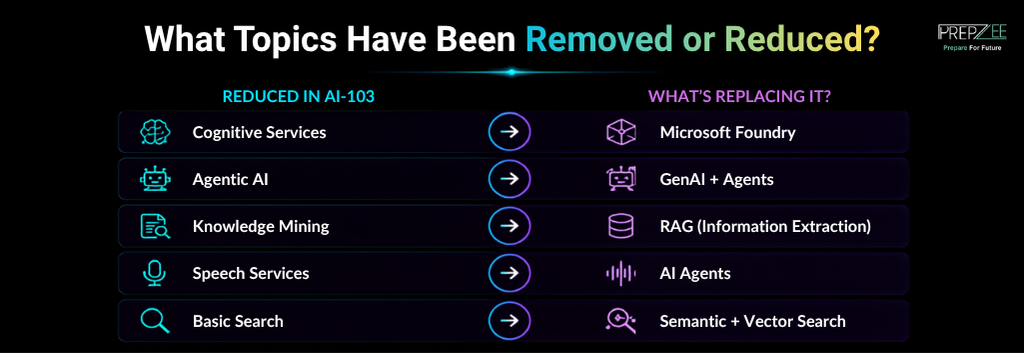
While AI-103 introduces several new technologies, Microsoft has also streamlined or reduced the emphasis on some legacy concepts. Rather than testing individual Azure AI services separately, the new exam evaluates how these services work together within modern AI applications.
Here are the key changes:
| Reduced in AI-103 | What’s Replacing It? |
| Azure Cognitive Services as standalone topics | Microsoft Foundry ecosystem |
| Separate Agentic AI domain | Merged into Generative AI and Agentic Solutions |
| Traditional Knowledge Mining | Information Extraction with RAG |
| Standalone Speech Services | Speech integrated into AI agents |
| Azure AI Studio terminology | Microsoft Foundry |
| Basic Search implementation | Semantic, hybrid, and vector search |
This doesn’t mean these technologies have disappeared—they’re simply tested within real-world AI development scenarios rather than as isolated services. Candidates should expect scenario-based questions that require combining multiple Azure AI capabilities to solve business problems.
AI-102 vs AI-103: Which Certification Should You Choose?
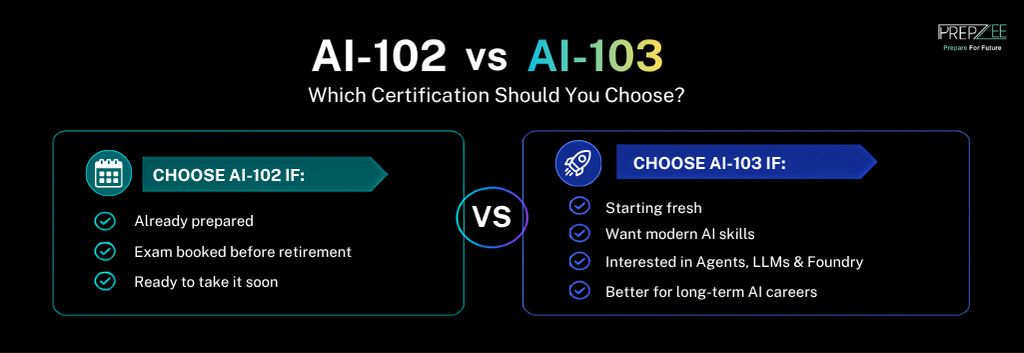
The right certification depends on your current preparation level and career goals.
Choose AI-102 If:
- You’ve already completed most of your AI-102 preparation.
- Your exam is scheduled before the retirement deadline.
- You’re confident you can pass before the exam is discontinued.
Since AI-102 is retiring, new learners should avoid starting their preparation unless they’re very close to taking the exam.
Choose AI-103 If:
- You’re beginning your Azure AI certification journey.
- You want skills aligned with Microsoft’s latest AI technologies.
- You’re interested in AI agents, LLMs, Microsoft Foundry, and enterprise AI development.
- You’re preparing for future AI engineering or AI application development roles.
For most professionals, AI-103 is the better long-term investment because it aligns with how organizations are building AI-powered applications today.
AI-102 Retirement and Migration Guide
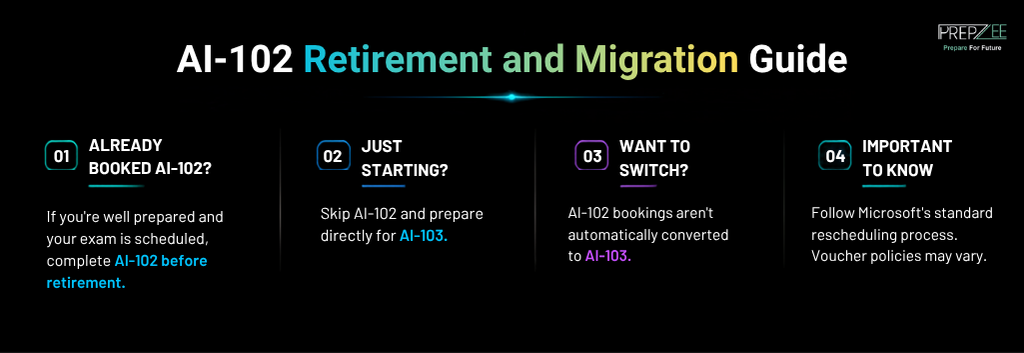
Microsoft has confirmed that AI-102 will retire on 30 June 2026, after which it can no longer be scheduled. During the transition period, AI-102 and AI-103 are available simultaneously, but Microsoft recommends that new candidates focus on AI-103 instead.
If You’ve Already Booked AI-102
If you’re well prepared and your exam is already scheduled, it makes sense to complete AI-102 before retirement. Your certification will remain valid according to Microsoft’s certification policy.
If You’re Just Starting
Skip AI-102 and prepare directly for AI-103. The newer certification includes modern AI concepts that employers increasingly expect, making it more valuable for long-term career growth.
Can You Transfer Your AI-102 Booking?
Microsoft does not automatically convert AI-102 registrations into AI-103. If you decide to switch, you’ll need to follow Microsoft’s standard exam rescheduling process, and voucher policies may vary depending on the type of voucher you purchased.
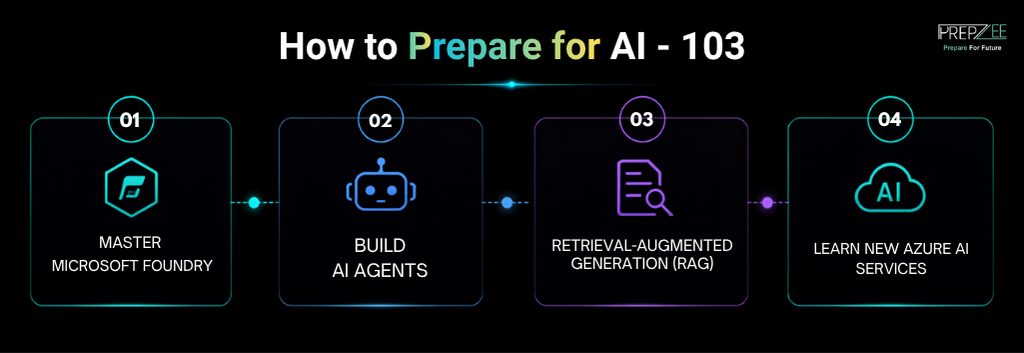
How to Prepare for AI-103
Microsoft Learn is an excellent place to understand the fundamentals of AI-103. However, to prepare effectively for the certification, you should also complete hands-on labs, build practical projects, and take mock tests. Combining theory with real-world implementation will strengthen your understanding and improve your confidence for the exam.
Prepzee offers certification guides, mock exams, and practical learning resources designed to help candidates build the hands-on skills required for Microsoft’s latest Azure AI certifications.
A structured preparation plan should include:
1. Master Microsoft Foundry
Learn how to create projects, deploy models, manage resources, and monitor AI applications using the new Microsoft Foundry environment.
2. Build AI Agents
Practice creating intelligent agents that can:
- Use external tools.
- Retrieve enterprise knowledge.
- Perform multi-step reasoning.
- Automate workflows.
Hands-on projects will help you understand concepts that are difficult to learn from documentation alone.
3. Practice Retrieval-Augmented Generation (RAG)
Since RAG is one of the most important additions to AI-103, make sure you understand:
- Azure AI Search.
- Vector search.
- Semantic search.
- Chunking strategies.
- Knowledge indexing.
- Grounding LLM responses with enterprise data.
4. Learn New Azure AI Services
As AI-103 evolves, these Azure AI services have become increasingly important for both the certification exam and real-world AI application development:
- Azure AI Content Understanding.
- Updated Document Intelligence capabilities.
- Speech integration for AI agents.
- Responsible AI configuration.
Building a solid understanding of these newer Azure AI services will help you stay aligned with the latest AI-103 exam objectives and Microsoft’s evolving AI ecosystem.
Final Thoughts
The transition from AI-102 to AI-103 marks Microsoft’s shift from service-based AI development to application-driven AI engineering. While AI-102 helped developers learn how to integrate Azure AI services, AI-103 prepares them to build intelligent, enterprise-ready AI applications powered by Microsoft Foundry, AI agents, and Retrieval-Augmented Generation (RAG).
For new learners, AI-103 is the clear choice. It reflects the technologies organizations are adopting today and equips developers with practical skills that extend beyond certification objectives.
If you’re already preparing for AI-102, complete the exam before its retirement if you’re ready. Otherwise, investing your time in AI-103 will provide stronger long-term value and keep your skills aligned with Microsoft’s evolving AI ecosystem.
Ready to Ace AI-103?
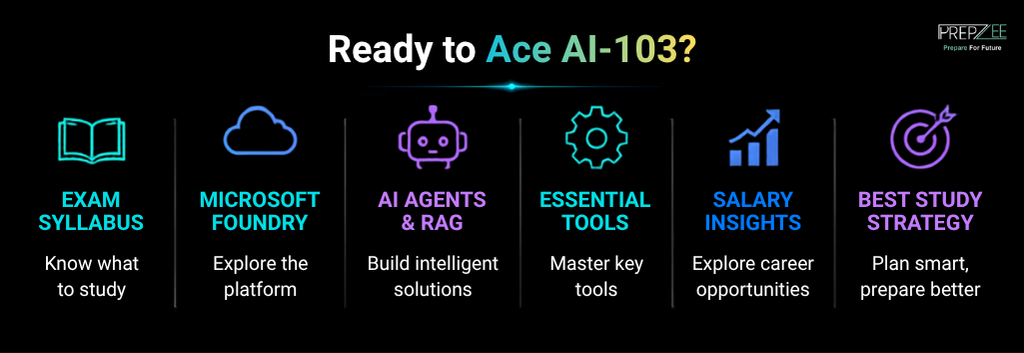
Now that you understand how AI-103 differs from AI-102, the next step is building a structured preparation plan. Our AI-103 Certification: Azure AI App & Agent Developer Certification in 2026 – A Quick Guide covers everything you need to know—from the exam syllabus and Microsoft Foundry to AI agents, RAG, essential tools, salary insights, and the best study strategy.
Pair it with Prepzee’s AI-103 practice tests to boost your confidence and maximize your chances of passing the exam on your first attempt.
Frequently Asked Questions
FAQ
AI-103 isn’t necessarily harder, but it’s more modern. Instead of testing individual Azure AI services, it evaluates your ability to build complete AI applications using Microsoft Foundry, AI agents, and Retrieval-Augmented Generation (RAG).
Only if you’ve already completed your preparation and can take the exam before it retires. Otherwise, AI-103 is the recommended certification because it reflects Microsoft’s current AI ecosystem.
Some of the most important additions include:
- Microsoft Foundry
- AI Agents
- Multi-agent orchestration
- Azure AI Content Understanding
- Advanced RAG pipelines
- Speech integration with AI agents
- Responsible AI configuration
These topics represent the largest changes from AI-102 and are central to the updated certification objective
Yes. However, these topics are now integrated into broader AI application scenarios. Instead of testing them independently, Microsoft expects candidates to understand how they work alongside LLMs, AI agents, and enterprise data.
Absolutely. Microsoft Foundry is one of the biggest additions to the certification. Candidates are expected to understand how to build, deploy, monitor, and manage AI applications using the Foundry platform.
Siddharth Sharma