



How AI is Transforming DevOps: Benefits, Use Cases & Career Opportunities

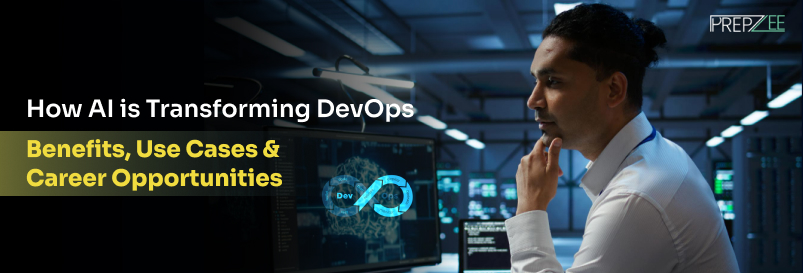
Table of content
The software industry is undergoing one of its most significant shifts in decades. As businesses race to deliver faster, more reliable software, two powerful forces have converged: AI in DevOps and intelligent automation. Together, they’re creating a new paradigm often called AIOps that promises to eliminate bottlenecks, predict failures before they happen, and supercharge development teams across the globe.
Whether you’re a developer looking to upskill, an IT professional eyeing a career shift, or a student planning your tech future, understanding how AI is reshaping DevOps is no longer optional. In this post, we break it all down from core benefits and real-world use cases to the certifications and career paths that will set you apart in a competitive job market.
What Is AI in DevOps?
DevOps, at its core, is the cultural and technical practice of unifying software development and IT operations to enable continuous delivery at high quality. It bridges the gap between the team that writes code and the team that deploys and maintains it creating a shared responsibility for the entire software lifecycle.
Artificial Intelligence enters this picture as an intelligent accelerant. By layering machine learning, natural language processing, and predictive analytics onto DevOps workflows, AI transforms what were once manual, reactive processes into smart, self-optimizing systems. The result is a pipeline that doesn’t just execute tasks it learns from them.
The combination of AI ML solutions with DevOps practices unlocks capabilities that neither discipline could achieve independently: pipelines that self-heal, monitoring systems that predict outages, and code review tools that catch vulnerabilities before they’re ever deployed.
Key Benefits of AI in DevOps
1. Automated, Self-Healing CI/CD Pipelines
One of the most transformative applications of AI in DevOps is in Continuous Integration and Continuous Deployment (CI/CD). AI enables pipelines to automatically build, test, and deploy code and critically, to detect and resolve issues without waiting for human intervention. When a deployment fails, an AI-powered pipeline can roll back automatically, alert the right team member, and even suggest a fix based on historical patterns.
2. Higher Code Quality at Scale
AI-powered code review tools analyse vast codebases in seconds, flagging bugs, security vulnerabilities, and inefficiencies that might elude even senior developers. Over time, these systems learn from every codebase they analyse, continuously refining their understanding of what “good code” looks like in your specific environment. This leads to higher quality software delivered in shorter cycles, a core goal of any DevOps course.
3. Predictive Monitoring & Reduced Downtime
Traditional monitoring tells you when something has gone wrong. AI-powered monitoring tells you before it does. By analysing metrics, logs, and user behaviour patterns in real time, AI ML solutions can identify anomalies that precede system failures giving operations teams precious lead time to act proactively rather than reactively.
4. Smarter Security (DevSecOps)
Security has historically been bolted onto the end of development cycles. AI changes this by embedding security intelligence directly into CI/CD pipelines. Automated vulnerability scanning, threat detection, and compliance checks run at every stage ensuring that security is baked in, not added on. This is increasingly essential for teams pursuing a DevOps certification course that covers modern DevSecOps practices.
5. Significant Cost Reduction
By automating repetitive tasks, optimising resource usage, and catching expensive bugs early in the development cycle, AI can reduce infrastructure and operational costs by up to 50%, according to industry reports. Teams spend fewer hours on manual testing, incident management, and debugging and more time on building features that create real value.
Real-World Use Cases
Theory only goes so far. Here’s how leading organisations are already putting AI in DevOps to work across the software development lifecycle:
Use Case 01- Intelligent Test Generation
AI tools like Diffblue and Testim automatically write and update unit tests based on code changes, dramatically shrinking QA cycles without sacrificing coverage.
Use Case 02- Anomaly Detection in Production
Companies like Netflix and Google use ML models to monitor millions of metrics in real time, flagging unusual patterns before they escalate into outages.
Use Case 03 – Generative AI Code Assistance
Tools like GitHub Copilot powered by generative AI suggest code completions, write boilerplate, and explain complex functions, boosting developer productivity by up to 55%.
Use Case 04- AI-Optimised Deployments
AI analyses historical deployment data to recommend optimal release windows, minimise rollback risk, and intelligently manage canary or blue-green deployments.
Use Case 05 – Incident Management & RCA
AIOps platforms like PagerDuty and Moogsoft automatically correlate alerts, suppress noise, and perform root cause analysis reducing mean time to resolution (MTTR) by over 60%.
Use Case 06- Smart Resource Provisioning
AI predicts infrastructure demand based on traffic patterns and automatically scales cloud resources up or down, eliminating both over-provisioning waste and under-provisioning risk.
The Rise of Generative AI in DevOps
If traditional AI in DevOps is about automation and prediction, generative AI takes it a step further by creating. Large Language Models (LLMs) are now being used to generate Infrastructure-as-Code (IaC) templates, write documentation, draft incident postmortems, create test scenarios from natural language descriptions, and even suggest architectural improvements.
For engineers, this means that natural language is becoming a new interface with the development toolchain. You can describe what you want in plain English and have an AI generate the Terraform config, Docker Compose file, or Kubernetes manifest. The teams that learn to work alongside these tools rather than around them will define the next generation of DevOps excellence.
Earning a generative AI certification alongside your DevOps credentials is rapidly becoming the differentiator that separates mid-level engineers from senior architects in today’s job market.
Challenges to Watch Out For
Despite its immense promise, integrating AI into DevOps isn’t without friction. Teams commonly encounter:
- Data quality issues – AI systems are only as good as the data they’re trained on; noisy or incomplete monitoring data leads to poor predictions
- Cultural resistance – Engineers may fear job displacement or distrust automated decisions, requiring change management alongside technical rollout
- Tool fragmentation – The AIOps ecosystem is crowded, and integrating multiple tools into a cohesive pipeline requires careful architectural planning
- Skills gaps – Most DevOps teams were not trained on AI/ML concepts, creating a need for targeted upskilling through a DevOps certification course
- Explainability – When AI makes an automated decision that affects production, teams need to understand why – black-box models create accountability gaps
Career Opportunities: The AI-DevOps Intersection
The demand for professionals who understand both DevOps principles and AI/ML capabilities has surged sharply. Organisations aren’t just hiring DevOps engineers or data scientists separately they’re looking for hybrid talent that can bridge the two worlds. Here’s a look at key roles and what they command in today’s market:
| Role | Key Skills | Avg. Salary (INR) |
| AIOps Engineer | ML, monitoring tools, CI/CD | ₹18–30 LPA |
| DevSecOps Engineer | Security automation, AI threat detection | ₹16–28 LPA |
| MLOps Engineer | ML pipelines, Kubernetes, cloud platforms | ₹20–36 LPA |
| Cloud AI Architect | AWS/Azure AI services, IaC, system design | ₹28–50 LPA |
| Platform Engineer (AI) | GenAI tools, DevOps platforms, LLM integration | ₹22–40 LPA |
Certifications That Will Fast-Track Your Career
In a competitive job market, certifications signal credibility and structured knowledge to hiring managers. If you’re looking to build a career at the intersection of AI and DevOps, these credentials are worth pursuing:
- DevOps Certification Course – Foundation-level credential covering CI/CD, containerisation, infrastructure automation, and agile collaboration
- Generative AI Certification – Covers LLMs, prompt engineering, RAG architectures, and deploying GenAI in production environments
- AWS DevOps Engineer Professional – Validates your ability to build and operate DevOps pipelines on AWS infrastructure
- Google Professional Cloud DevOps Engineer – Demonstrates mastery of SRE principles and GCP-native DevOps tooling
- AI ML Solutions Architect – Advanced credential for professionals designing end-to-end AI/ML infrastructure at enterprise scale
At Prepzee, our structured learning paths are specifically designed to help you earn these credentials with confidence – combining conceptual depth, hands-on labs, and exam-focused preparation so you’re ready not just for the test, but for the job.
The Road Ahead
The integration of AI in DevOps is still in its early innings. As foundation models become more capable and AI tooling matures, we can expect fully autonomous pipeline orchestration, AI-generated architecture recommendations, and self-optimising microservices infrastructures to become standard not cutting-edge.
The engineers who invest in learning AI ML solutions, earn a generative AI certification, and complement that with a strong DevOps certification course will be the ones shaping how software is built in 2026 and beyond. The question is simply: will you be one of them?


