


Prepzee’s Forward Deployed AI Engineer Program: Skills, Training & Projects

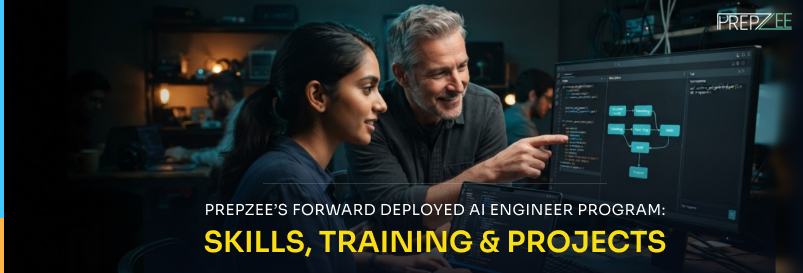
Table of content
- What Does a Forward Deployed AI Engineer Do?
- Forward Deployed AI Engineering Program at a Glance
- Inside the Forward Deployed AI Engineering Curriculum
- Five Real-World AI Projects You'll Build
- Tools and Technologies Covered
- Who Can Benefit From This Program?
- Placement Assistance and Career Support
- Career Opportunities in Forward Deployed AI Engineering
- Ready to Build AI Systems That Work in Production?
- Frequently Asked Questions
- FAQ
An AI prototype can work perfectly during a demonstration and still struggle when connected to real business systems.
Customer data may be scattered across databases, APIs may behave differently than expected, and security requirements can complicate deployment. Solving these problems requires more than knowing how to build an AI model.
That’s where Forward Deployed AI Engineers (FDEs) play an important role.
They work closely with businesses to understand requirements, develop AI applications, and deploy solutions that operate reliably in production.
Prepzee’s Forward Deployed AI Engineering program focuses on these practical skills through structured learning, hands-on projects, and career preparation.
Here’s a closer look at the curriculum, technologies, projects, and career support included in the program.
What Does a Forward Deployed AI Engineer Do?
A Forward Deployed AI Engineer connects AI development with business problem-solving.
For example, a company may want an AI assistant that answers employee questions using internal documents. Building the chatbot is only the beginning. The engineer must connect company data, manage access permissions, test response accuracy, and deploy the application.
The role involves:
- Understanding customer requirements and identifying suitable AI solutions.
- Developing applications using LLMs, RAG, and AI agents.
- Integrating AI systems with databases and enterprise software.
- Managing security, deployment, monitoring, and performance.
- Collaborating with stakeholders throughout implementation.
For a broader learning path, explore the Forward Deployed Engineer roadmap.
Forward Deployed AI Engineering Program at a Glance
The program combines live training, technical assignments, production-style AI projects, and career preparation.
| Program Details | Overview |
|---|---|
| Duration | 20 weeks |
| Live Training | 120+ hours |
| Curriculum | 9 modules |
| Hands-On Projects | 5 production-style projects |
| Learning Format | Live instructor-led sessions |
| Learning Support | Class recordings and technical assistance |
| Career Support | Resume guidance, interview preparation, and job-opportunity guidance |
The curriculum progresses from Python fundamentals to advanced AI applications, enterprise system design, and client-facing engineering.
Inside the Forward Deployed AI Engineering Curriculum
Module 1: Python & API Development
The learning journey begins with Python fundamentals, including data structures, functions, file handling, and error management.
Learners then explore REST APIs, asynchronous programming, and FastAPI to understand how AI applications communicate with external systems.
Key skills: Python, FastAPI, REST APIs, Pydantic, debugging, and authentication.
Module 2: Vibe Coding & AI-Assisted Development
AI coding assistants can accelerate development, but engineers must still understand and review the code they produce.
This module introduces Cursor and Claude Code alongside requirement planning, code generation, debugging, and testing.
Learners practice identifying incorrect implementations, security problems, and potential failures in AI-generated code.
Module 3: LLMs & Prompt Engineering
Large Language Models form the foundation of many modern AI applications.
This module explains transformer architecture, tokenization, attention mechanisms, and context windows.
It also covers practical prompting techniques, including:
- Zero-shot and few-shot prompting.
- System and role-based instructions.
- Prompt optimization and debugging.
- OpenAI, Claude, and Gemini API integration.
- Function calling and structured JSON outputs.
These concepts help learners build applications that generate more consistent and useful responses.
Module 4: RAG & Vector Intelligence
Retrieval-Augmented Generation (RAG) allows AI applications to retrieve relevant information from external sources before generating answers.
Learners explore embeddings, semantic search, document chunking, and vector databases such as FAISS and ChromaDB.
Advanced topics include hybrid retrieval, reranking, and techniques for reducing hallucinations.
These skills are valuable when developing enterprise knowledge assistants and document-search applications.
Module 5: AI Agents
AI agents extend beyond simple question-and-answer systems by using tools and completing multi-step tasks.
Using LangChain, learners explore agent workflows, decision-making, external API connections, and memory management.
The module also introduces short-term and long-term memory, context management, and workflow orchestration.
Module 6: Multi-Agent Systems
Complex applications sometimes require multiple specialized AI agents working together.
This module introduces LangGraph for building stateful workflows and coordinating multiple agents.
Learners also explore Model Context Protocol (MCP), agent communication, task delegation, and controlled execution.
The focus is on designing AI systems capable of handling more complex workflows.
Module 7: AI System Design
A working AI application must also meet expectations for reliability, security, scalability, and cost.
This module covers enterprise architecture, API contracts, database integration, and system communication.
Learners explore architecture diagrams, failure-handling strategies, cloud versus on-premise deployment, and technical trade-offs.
Module 8: LLMOps & Deployment
Moving AI applications into production requires monitoring, testing, and deployment practices.
This module introduces Docker, GitHub Actions, AWS, and LangSmith.
Learners cover model evaluation, hallucination detection, regression testing, logging, latency monitoring, and cost optimization.
The objective is to understand how AI applications are deployed, maintained, and improved after release.
Module 9: Forward Deployed AI Engineering
The final module brings technical development together with customer-facing responsibilities.
It covers:
- Customer discovery and requirement gathering.
- Business workflow mapping and solution scoping.
- Enterprise APIs, authentication, and data privacy.
- Legacy-system integration and technical documentation.
- User acceptance testing and production handover.
- Stakeholder communication and impact reporting.
This module focuses on turning business requirements into practical AI solutions.
Five Real-World AI Projects You’ll Build
Understanding concepts matters, but applying them to practical problems is equally important.
The program includes five production-style projects covering different AI engineering use cases.
| Project | What You’ll Build |
|---|---|
| Multi-Agent AI Assistant | An assistant that coordinates specialized AI agents to complete complex tasks |
| OpsPilot | An AI-powered incident investigation and resolution system |
| ScamGuard AI | A system that identifies potential scams and explains risk indicators |
| SupportIQ | An AI customer support system generating context-aware responses |
| HireFlow | An intelligent candidate search and evaluation application |
These projects provide practical exposure to AI orchestration, semantic search, APIs, enterprise workflows, and application architecture.
They also give learners portfolio examples to discuss during technical interviews.
Tools and Technologies Covered
The curriculum introduces several tools used in AI application development.
| Category | Technologies |
|---|---|
| Programming | Python, FastAPI, Pydantic |
| LLM Development | OpenAI, Claude, Gemini |
| RAG & Search | FAISS, ChromaDB |
| AI Agents | LangChain, LangGraph |
| Integration | REST APIs, MCP |
| Deployment | Docker, AWS, GitHub Actions |
| Monitoring | LangSmith |
Learning how these technologies work together helps engineers understand complete AI development workflows.
Who Can Benefit From This Program?
Forward Deployed AI Engineering draws on skills from several technical fields.
The training may suit:
- Software developers interested in building AI-powered applications.
- Data professionals looking to work with RAG, data integration, and LLM systems.
- QA engineers exploring AI testing and automation.
- Cloud and DevOps professionals interested in AI deployment and infrastructure.
- IT operations professionals seeking skills in enterprise AI integration.
Previous software or IT experience provides a useful foundation for progressing into applied AI engineering.
Placement Assistance and Career Support
Learning technical skills is one part of preparing for an AI engineering career. Presenting those skills effectively during recruitment is another.
The program includes career guidance designed to help learners prepare for relevant opportunities.
Placement assistance covers:
- Resume Building: Guidance on presenting technical experience, AI projects, and relevant skills.
- Interview Preparation: Expert-led support for explaining project decisions, architecture, and technical concepts.
- Job Opportunity Guidance: Assistance in identifying relevant Forward Deployed AI Engineering opportunities.
This support can help learners prepare for interviews and communicate their practical experience more effectively.
Employment outcomes depend on individual skills, previous experience, interview performance, and employer requirements.
Career Opportunities in Forward Deployed AI Engineering
The curriculum develops capabilities relevant to roles such as Forward Deployed AI Engineer, Applied AI Engineer, AI Solutions Engineer, GenAI Engineer, and AI Application Developer.
Responsibilities and compensation vary depending on the employer, location, and level of experience.
Engineers exploring opportunities in India can review the Forward Deployed Engineer salary guide for additional career information.
Ready to Build AI Systems That Work in Production?
Forward Deployed AI Engineering requires more than familiarity with AI tools. It combines development, integration, deployment, and business problem-solving.
With nine curriculum modules, five practical projects, live instructor-led sessions, and career preparation support, Prepzee provides a structured learning path for engineers interested in this field.
Explore the training curriculum and see how it aligns with your current skills and career goals.
View the Forward Deployed AI Engineer Course
Frequently Asked Questions
1. How long is the Forward Deployed AI Engineering program?
The program runs for 20 weeks and includes more than 120 hours of live training.
2. Do I need machine learning experience to join?
A machine learning background can be useful, but professionals with software development, data, QA, cloud, or IT experience may also benefit.
3. What projects are included?
The program includes five projects covering multi-agent assistants, incident response, scam detection, customer support, and candidate evaluation.
4. Does the program include placement assistance?
Yes. Career support includes resume-building guidance, expert-led interview preparation, and guidance on relevant job opportunities. Placement is not guaranteed.
FAQ
The program runs for 20 weeks and includes more than 120 hours of live training.
A machine learning background can be useful, but professionals with software development, data, QA, cloud, or IT experience may also benefit.
The program includes five projects covering multi-agent assistants, incident response, scam detection, customer support, and candidate evaluation.
Yes. Career support includes resume-building guidance, expert-led interview preparation, and guidance on relevant job opportunities. Placement is not guaranteed.
Siddharth Sharma