



The Top AI Certifications for 2026

Table of content
Artificial Intelligence (AI) and Machine Learning (ML) are no longer just buzzwords—they’re transforming every industry, from healthcare and finance to retail and manufacturing. For professionals aiming to future-proof their careers, investing in the right AI ML certification is one of the smartest moves you can make.
The global AI market is projected to reach $407 billion by 2027 (IDC), and organizations are aggressively seeking skilled talent who can build intelligent systems, automate processes, and extract insights from massive datasets. This has led to an enormous demand for structured AI certification programs that provide both hands-on training and industry-recognized credentials.
Whether you work in IT, data analysis, or software development, getting certified in AI can help you get better jobs. These programs teach important topics like neural networks, deep learning, and building AI models. They include both lessons and hands-on projects, so you learn the theory and how to apply it.
AI is changing many businesses fast. Choosing the right course will help you keep your skills up-to-date and prepare you for future jobs. It’s not just about learning new skills, but about staying competitive and ready for what’s coming next.
How to Choose The Right AI Certification Path?
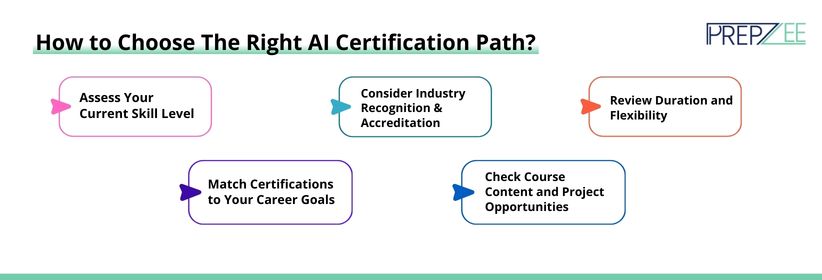
Selecting the ideal AI certification can feel overwhelming, given the breadth of options available today. Whether you’re just starting out or looking to deepen your expertise, the right AI machine learning certification can accelerate your career by equipping you with crucial skills and validating your knowledge to employers. With AI transforming industries at a rapid pace, choosing an AI certificate course that matches your goals, background, and preferred technologies is essential for success.
Here are key factors to consider when choosing your AI Machine Learning Certification path:
- Assess Your Current Skill Level: Beginners should look for foundational courses that build a strong base in AI and machine learning concepts without heavy prerequisites. More advanced learners can opt for specialized certifications focusing on deep learning, computer vision, or cloud AI services.
- Match Certifications to Your Career Goals: If you want hands-on cloud experience, certifications from AWS, Google Cloud, or Microsoft Azure are invaluable. For academic rigor and theory, programs like Stanford’s AI Graduate Certificate are highly respected.
- Consider Industry Recognition and Accreditation: Opt for certifications that are widely recognized by employers and offer practical project experience to demonstrate your capabilities.
- Check Course Content and Project Opportunities: The best AI certificate courses balance theory with real-world applications, covering essential topics like neural networks, natural language processing, and ML pipelines.
- Review Duration and Flexibility: Choose a program that fits your schedule and learning pace—many leading certifications offer self-paced online options.
Thoughtfully selecting your AI machine learning certification, you can ensure it aligns with your ambitions and sets you up for rewarding opportunities in the evolving AI landscape.
Why Choose AI Certification?
Choosing to pursue an AI and ML certification has become a strategic career move in today’s rapidly evolving technological landscape. Artificial intelligence (AI) is changing many industries like healthcare, finance, retail, and manufacturing. Because of this, professionals with skills in AI are in high demand.
Reports say the AI market will grow very fast, over 40% every year until the late 2020s. This means more companies will need experts who can create, manage, and use intelligent AI systems. So, having AI certification and skills will be very important for jobs in the future. Another reason to choose AI certification is the structured learning path that these courses offer.
Unlike self-study or piecemeal training, well-designed AI ML certification courses provide comprehensive coverage of critical topics such as machine learning algorithms, deep learning frameworks, neural networks, and data handling techniques. With a certification, you’re not only gaining knowledge, but also showcasing your commitment and ability to apply AI technologies effectively.Getting an AI certification can open many good job opportunities.
Certified professionals often earn higher salaries and can work in roles such as AI engineer, data scientist, machine learning specialist, and AI consultant. Whether you’re an IT professional looking to pivot or a tech enthusiast seeking advanced skills, investing in AI and ML certification is a powerful way to future-proof your career and remain competitive in an AI-driven world.
AI Certifications For Beginners vs. Advanced Learners
The right AI certification depends largely on your current knowledge and career objectives. For those just starting out, foundational AI ML courses provide essential concepts and practical skills needed to build a strong base in artificial intelligence and machine learning.
On the other hand, advanced learners seeking to deepen their expertise or specialize in specific domains can benefit from more comprehensive certifications. These programs often focus on complex techniques, scalability, and industry-specific applications. For example, professionals targeting roles such as Azure AI Engineer or data science leadership are likely to opt for advanced training, sometimes referred to as an AI and data science course, that covers cloud AI services, automated machine learning, and deployment strategies.
The table below highlights key differences between beginner and advanced AI certification paths to help you find the best fit for your goals.
| Feature | Beginner AI Certifications | Advanced AI Certifications |
| Target Audience | Newcomers to AI, students | Experienced professionals, specialists |
| Course Focus | Fundamentals of AI | Deep learning, cloud AI, |
| Complexity | Low to moderate | High |
| Hands-on Projects | Basic datasets and simplified projects | Real-world projects, large datasets, cloud integration |
| Examples | Introductory AI ML courses like Coursera AI Fundamentals | Specialized courses like Microsoft Azure AI Engineer |
| Career Outcomes | Roles like AI analyst, junior data scientist | Roles like Azure AI Engineer |
| Prerequisites | None or minimal technical background | Strong programming and math skills required |
| Duration | Weeks to a few months | Months, often part-time or intensive full-time |
Selecting the right certification depends on your experience, current role, and ambition in the AI field. Beginners should start with comprehensive AI ML courses that build confidence and knowledge, while experienced professionals may pursue specialized paths such as the Azure AI Engineer certification to excel in complex AI roles.
The Best AI Certifications For 2026
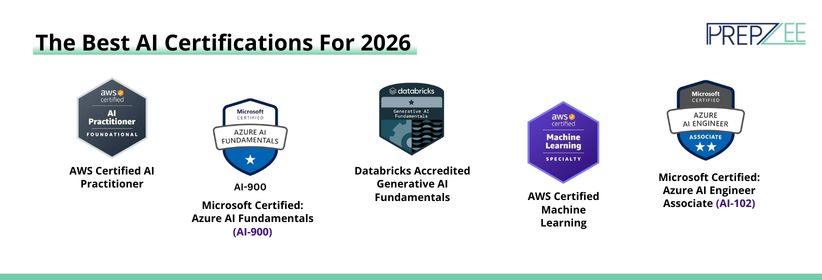
Staying ahead means equipping yourself with recognized credentials that validate your expertise and open doors to exciting career opportunities. The best AI ML certification programs combine comprehensive theoretical knowledge with practical, hands-on experience, enabling learners to master cutting-edge technologies such as machine learning, deep learning, natural language processing, and cloud-based AI services. Let’s have a closer look at these five certifications in more detail.
1. AWS Certified AI Practitioner (NEW – 2024)
AWS Certified AI Practitioner certification serves as an excellent starting point for those new to AI and cloud technologies. It introduces you to foundational AI and machine learning concepts along with practical AWS AI tools.
- Level: Foundational
- Focus: AI/ML basics, generative AI, AWS AI services (Bedrock, SageMaker, Recognition, Polly, Lex)
- Good for: Beginners wanting to understand AI concepts and AWS AI tools
- Exam Duration: ~90 minutes
- Prerequisites: None
- A highly recommended option within AI ML certification courses designed for fresh learners
- Price:
- Global: $100-$250
- India: ₹7,000 – ₹8,400
2. Microsoft Certified: Azure AI Fundamentals (AI-900)
Ideal for beginner professionals, the Azure AI Fundamentals (AI-900) certification covers essential AI concepts and practical applications within the Microsoft Azure ecosystem. It is suitable for both technical and business professionals starting their AI journey.
- Level: Entry-level / Fundamentals
- Focus: Core AI concepts, machine learning principles, Azure AI services (Cognitive Services, Azure ML, Conversational AI)
- Good for: Beginners, business/technical professionals starting in AI
- Exam Duration: ~60 minutes
- Prerequisites: None
- A foundational AI certificate course for building Microsoft Azure AI skills
- Price:
- Global: $85 – $100
- India: ₹6,000 – ₹10,000
3. Databricks Accredited Generative AI Fundamentals (Free, 2024)
Databricks Accredited Generative AI Fundamentals free certification targets beginners eager to explore the rapidly evolving field of generative AI, focusing on large language models and prompt engineering using Databricks tools. It’s a great entry into the world of generative AI technologies.
- Level: Beginner
- Focus: Generative AI concepts, LLMs, prompt engineering, Databricks AI tools
- Good for: Anyone starting in generative AI, especially those using Databricks
- Part of foundational AI and ML certification programs with practical insights
- Price: Free (Global & India)
Advanced / Specialty Level Certifications
4. AWS Certified Machine Learning – Specialty
Designed for experienced AI practitioners, the AWS Certified Machine Learning – Specialty certification covers the comprehensive machine learning lifecycle, emphasizing practical model deployment and tuning on AWS. It’s suited for professionals ready to deepen their ML expertise.
- Level: Specialty (Advanced)
- Focus Areas: End-to-end ML lifecycle, Amazon SageMaker mastery, ML algorithm optimization, business case alignment
- Prerequisites: Recommended 1–2 years of hands-on ML experience, knowledge of Python and ML frameworks like TensorFlow, PyTorch, MXNet
- Who It’s For: Data scientists, ML engineers, experienced data engineers
- A recognized AI machine learning certification< for advanced career growth
- Price:
- Global: $300 – $350
- India: ₹21,000 – ₹35,000
5. Microsoft Certified: Azure AI Engineer Associate (AI-102)
Azure AI Engineer Associate (AI-102) intermediate-level certification empowers AI engineers and developers to design and deploy AI solutions on Azure, incorporating services like cognitive APIs and conversational AI. It’s ideal for professionals integrating AI into enterprise applications.
- Level: Associate (Intermediate)
- Focus Areas: Designing and managing AI solutions with Azure Cognitive Services, Bot Service, AI Search; API and SDK integration
- Prerequisites: Recommended Azure and AI workflow experience; programming knowledge in C# or Python
- Who It’s For: AI engineers, software developers working extensively with AI
- A key credential among AI certification programs for Microsoft Azure AI specialists
- Price:
- Global: $165 – $250
- India: ₹12,000 – ₹25,000
Top AI Certifications Compared
With the rapid growth of artificial intelligence, choosing the right certification can be a crucial step toward advancing your career. This comparison highlights some of the leading AI certifications available today, helping you make an informed decision on the best path to elevate your knowledge and professional standing in AI.
| Certification | Level | Focus | Good For | Exam Duration | Prerequisites |
| AWS Certified AI Practitioner (NEW – 2024) | Foundational | AI/ML basics, generative AI, AWS AI services | Beginners wanting to understand AI concepts and AWS AI tools | ~90 minutes | None |
| Microsoft Certified: Azure AI Fundamentals (AI-900) | Entry-level / Fundamentals | Core AI concepts, machine learning principles, Azure AI services | Beginners, business/ technical professionals starting in AI | ~60 minutes | None |
| Databricks Accredited Generative AI Fundamentals (Free, 2024) | Beginner | Generative AI concepts, LLMs, prompt engineering, Databricks AI tools | Anyone starting in generative AI, especially Databricks users | No fixed duration (Free course) | None |
| AWS Certified Machine Learning – Specialty | Specialty (Advanced) | End-to-end ML lifecycle, Amazon SageMaker mastery, ML algorithm optimization | Data scientists, ML engineers, experienced data engineers | Varies | Recommended 1–2 years hands-on ML experience; Python |
| Microsoft Certified: Azure AI Engineer Associate (AI-102) | Associate (Intermediate) | Designing/
managing AI solutions with Azure Cognitive Services, |
AI engineers, software developers working extensively with AI | Varies | Recommended experience with Azure AI workflows; |
Making Your AI Certification Decision: Key Takeaways
Making your AI certification decision is a pivotal step toward advancing your career in a rapidly evolving field. Carefully assessing your current skills, career goals, and preferred learning style, you can select a program that not only builds your expertise but also aligns with industry demands.
Whether you choose a foundational AI and data science course to start your AI journey or advanced AI ML certification courses to specialize, the right credential will equip you with practical skills and open doors to rewarding opportunities. Ultimately, investing in a reputable AI certification ensures you stay competitive, confident, and prepared for the future of work.
FAQ
In 2026, AI certifications are important because AI technologies are being widely adopted across industries. Certifications help professionals stay competitive, validate in-demand skills, and meet employer expectations in a rapidly evolving job market.
Some of the top AI certifications for 2026 include:
- Databricks AI and Machine Learning Certifications
- Microsoft Azure AI Engineer Associate
- Google Professional Machine Learning Engineer
- AWS Certified Machine Learning – Specialty
- TensorFlow Developer Certificate
- IBM AI Engineering Professional Certificate
These certifications align with industry needs and future AI job roles.
AI certifications are suitable for data scientists, machine learning engineers, data engineers, software developers, cloud professionals, and individuals looking to transition into AI-focused roles.
Yes, many AI certifications offer beginner or associate-level tracks. These are ideal for learners with basic programming knowledge who want to build a strong foundation in artificial intelligence and machine learning.
AI certification exams typically assess:
- Python programming
- Machine learning and deep learning concepts
- Data preprocessing and model evaluation
- Neural networks and algorithms
- AI model deployment and optimization
- Ethical and responsible AI practices
Preparation time depends on prior experience:
- Beginners: 2–4 months
- Intermediate professionals: 4–8 weeks
- Experienced professionals: 2–4 weeks
Hands-on practice and real-world projects can accelerate learning.
Yes, AI certifications can significantly enhance career prospects by improving job opportunities, increasing salary potential, and providing recognition from employers for validated skills.
AI-certified professionals often earn higher salaries compared to non-certified peers. In 2026, salary increases of 15–30% are common, depending on role, location, and experience.
Yes, AI certifications provide structured learning paths that help professionals transition into AI roles, especially when combined with hands-on projects and real-world experience.
Common tools include Python, TensorFlow, PyTorch, Scikit-learn, cloud AI services, data pipelines, and model deployment frameworks.
Beginners should start with entry-level or associate certifications, while experienced professionals can pursue advanced or professional-level AI certifications aligned with their career goals.
AI certifications in Machine Learning, Generative AI, Data Science, AWS, and Microsoft Azure are among the most in-demand in 2026. As organizations continue to adopt AI-powered solutions, employers seek professionals with validated expertise in AI development, cloud computing, and intelligent automation. Industry-recognized AI certifications demonstrate practical skills, improve employability, and prepare professionals for roles such as AI Engineer, Machine Learning Engineer, Data Scientist, and AI Consultant across various industries.
The best AI certification depends on your career goals and technical background. Professionals aiming for roles in artificial intelligence, machine learning, or cloud AI should choose certifications that cover AWS, Microsoft Azure, Python, Generative AI, and Machine Learning. Programs that combine industry-recognized credentials with hands-on projects and real-world case studies help learners develop job-ready skills and increase their opportunities for career advancement in the rapidly evolving AI industry.
Being AI certified means you have successfully completed a recognized training program or certification exam that validates your knowledge of artificial intelligence concepts, machine learning techniques, cloud AI services, and real-world AI applications. An AI certification demonstrates your ability to work with modern AI technologies, implement intelligent solutions, and apply industry best practices. Certifications in AWS AI and Microsoft Azure AI further showcase your expertise in building and deploying AI applications on leading cloud platforms.
Industry-recognized AI credentials are typically earned through structured learning paths that combine instructor-led training, self-paced learning, practical labs, capstone projects, and certification exam preparation. The most effective AI training programs cover Machine Learning, Generative AI, Python, AWS, Microsoft Azure, and cloud-based AI technologies while providing hands-on experience. Choosing a program aligned with current industry requirements ensures you develop practical skills that are recognized by employers worldwide.
Globally recognized Machine Learning certifications focus on practical AI development, model deployment, cloud-based machine learning, and real-world business applications. Certifications related to AWS Machine Learning, Microsoft Azure AI, and other industry-leading AI platforms are widely accepted by employers across technology, finance, healthcare, and manufacturing sectors. These certifications validate your ability to build, train, evaluate, and deploy machine learning models using modern AI tools and cloud technologies.


