




What Is a Forward Deployed Engineer? Role, Skills, Salary & Career Path in 2026

Table of content
- What Is a Forward Deployed Engineer?
- What Does a Forward Deployed Engineer Do?
- FDE vs Software Engineer vs Solutions Engineer
- Skills You Need to Become a Forward Deployed Engineer
- AI and Generative AI Skills for FDEs
- Forward Deployed Engineer Salary in the USA
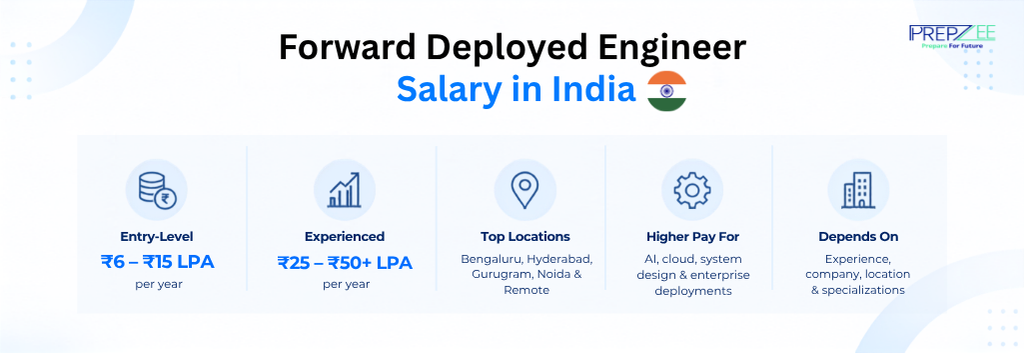
- Forward Deployed Engineer Salary in India
- Companies Hiring Forward Deployed Engineers in 2026
- How to Become a Forward Deployed Engineer: Practical Roadmap
- Is Forward Deployed Engineering a Good Career in 2026?
- Final Takeaway
- FAQ
Forward Deployed Engineer, or FDE, is becoming one of the most important technical roles in the AI and enterprise software industry. Companies today need more than engineers who build products. They also need people who can take those products into real customer environments, solve complex business problems, and make the technology work in production.
That is exactly what a Forward Deployed Engineer does.
An FDE combines software engineering, system design, cloud, data, AI, and customer-facing problem solving. For professionals who enjoy both coding and solving real business problems, it can be a strong career option in 2026.
What Is a Forward Deployed Engineer?
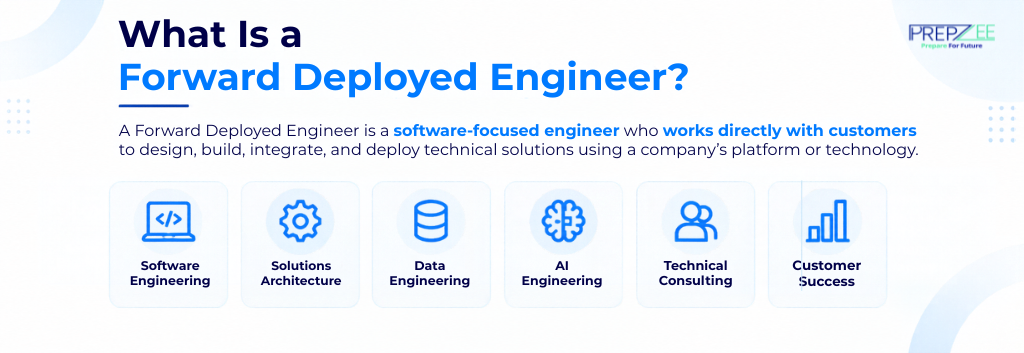
A Forward Deployed Engineer is a software-focused engineer who works directly with customers to design, build, integrate, and deploy technical solutions using a company’s platform or technology.
Instead of working only on a core product, an FDE works close to the customer.
The role became widely known through companies such as Palantir, where engineers were embedded with clients to solve complex data and operational problems. Today, the model is increasingly used by AI companies, enterprise software providers, cloud platforms, and technology startups.
An FDE typically combines responsibilities from:
- Software engineering
- Solutions architecture
- Data engineering
- AI engineering
- Technical consulting
- Customer success
The key difference is ownership. An FDE does not just recommend a solution. They often help build and deploy it.
What Does a Forward Deployed Engineer Do?
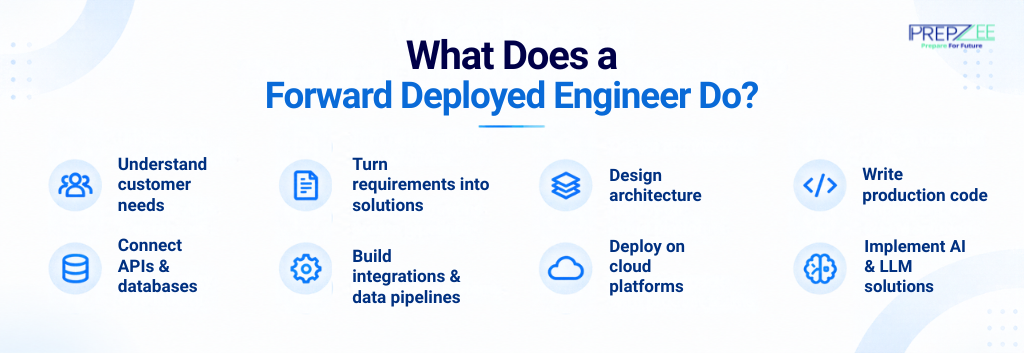
An FDE usually works across the complete customer deployment lifecycle.
Typical responsibilities include:
- Understanding customer workflows and technical problems
- Converting business requirements into technical solutions
- Designing system architecture
- Writing production-level code
- Connecting APIs, databases, and enterprise tools
- Building data pipelines and integrations
- Deploying applications on cloud platforms
- Implementing AI or LLM-based solutions
- Testing performance, security, and reliability
- Monitoring deployed systems
- Sharing customer feedback with product teams
For example, if a company wants to use Generative AI to search thousands of internal documents, an FDE may build the retrieval pipeline, connect the company’s data, integrate an LLM, add security controls, and deploy the final application.
This makes the role much broader than simple software configuration.
FDE vs Software Engineer vs Solutions Engineer
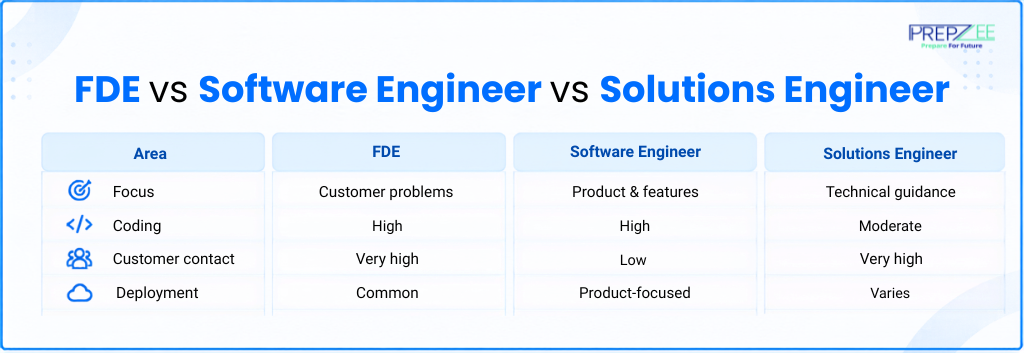
These roles can overlap, but their main goals are different.
| Area | Forward Deployed Engineer | Software Engineer | Solutions Engineer |
| Main focus | Customer-specific solutions | Core product development | Technical solution guidance |
| Coding | High | High | Moderate to high |
| Customer interaction | Very high | Usually low | Very high |
| Production deployment | Common | Product-focused | Varies |
| Business understanding | Very important | Depends on role | Very important |
| Pre-sales involvement | Sometimes | Rare | Common |
| End-to-end ownership | High | Product feature focused | Often advisory |
A Software Engineer usually builds features for a product used by many customers.
A Solutions Engineer generally helps customers understand how a product can solve their problems and may support demos, architecture discussions, and proofs of concept.
An FDE usually goes further by actually building and deploying the customer-specific solution.
Skills You Need to Become a Forward Deployed Engineer
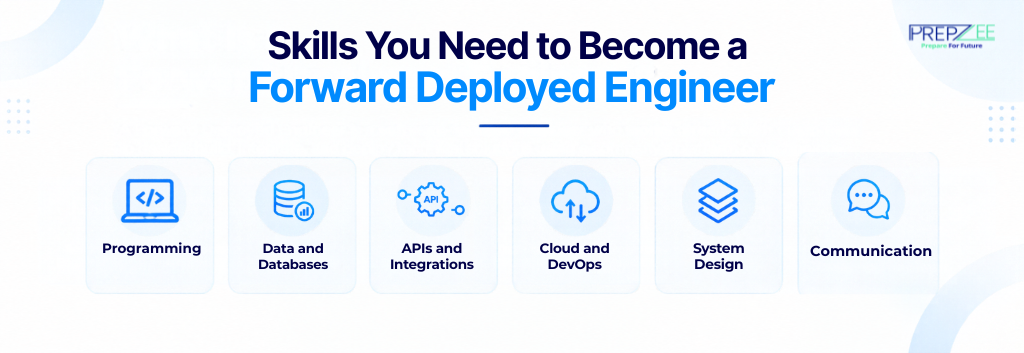
FDEs need a broad technical skill set because the role sits between engineering and business implementation.
Programming
Python is especially useful because it is widely used in backend development, automation, data engineering, and AI. Depending on the company, Java, JavaScript, TypeScript, Go, or C++ may also be useful.
Data and Databases
You should understand:
- SQL
- Relational databases
- Data modeling
- ETL and ELT
- Data pipelines
- NoSQL systems
- Data quality
APIs and Integrations
Enterprise systems rarely work independently. FDEs should be comfortable with APIs, authentication, webhooks, and third-party integrations.
Cloud and DevOps
Useful technologies include:
- AWS, Azure, or Google Cloud
- Docker
- Kubernetes
- Linux
- CI/CD
- Monitoring and observability
System Design
You should understand scalability, reliability, latency, security, APIs, and distributed system fundamentals.
Communication
An FDE must also communicate clearly with both technical and non-technical stakeholders. Being able to understand an unclear business problem and turn it into a working technical solution is one of the most important skills in the role.
AI and Generative AI Skills for FDEs
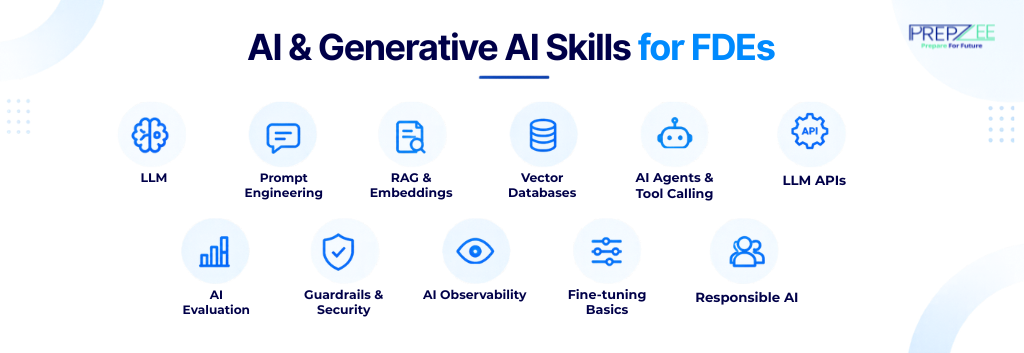
Generative AI is making the FDE role even more important.
Enterprises may have access to powerful AI models, but those models still need to connect with company data, business workflows, security systems, and existing applications.
For AI-focused Forward Deployed Engineer roles, understanding Generative AI and AI agents skills are becoming increasingly valuable, especially when working with enterprise LLM applications, RAG systems, and production AI deployments, useful skills include:
- Large Language Models
- Prompt engineering
- Retrieval-Augmented Generation (RAG)
- Embeddings
- Vector databases
- AI agents
- Tool and function calling
- LLM APIs
- AI evaluation
- Guardrails
- AI observability
- Fine-tuning fundamentals
- Responsible AI and security
A strong FDE should also understand when AI is not the best solution.
Production AI requires more than building a chatbot. Engineers must consider cost, latency, accuracy, security, reliability, and measurable business value.
Forward Deployed Engineer Salary in the USA
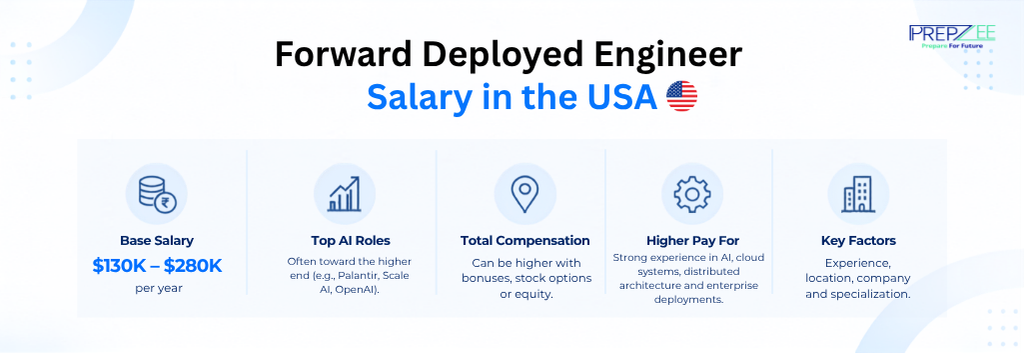
Forward Deployed Engineer salaries in the United States can be attractive, especially at AI and enterprise technology companies.
As of 2026, compensation can vary significantly depending on experience, company, location, and specialization.
Public job listings show that many FDE positions can fall within a base salary range of roughly $130,000 to $280,000 per year, with experienced AI-focused roles often appearing toward the higher end.
For example, companies such as Palantir, Scale AI, and OpenAI have advertised Forward Deployed Engineering roles with six-figure base compensation.
Total compensation may be higher when bonuses, stock options, or equity are included.
Candidates with strong experience in AI, cloud systems, distributed architecture, and enterprise deployments may command higher salaries.
For detailed salary ranges by experience, location and employer, see our Forward Deployed Engineer salary in USA guide.
Companies Hiring Forward Deployed Engineers in 2026
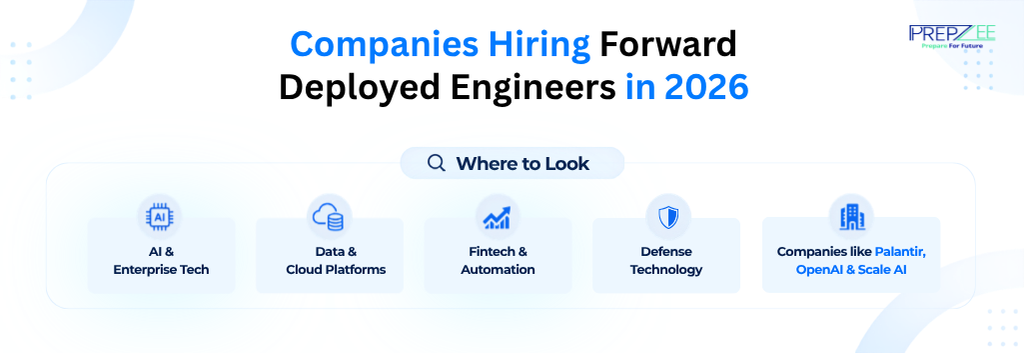
Forward Deployed Engineering is no longer limited to one or two companies.
Organizations associated with FDE or similar roles include:
- Palantir
- OpenAI
- Scale AI
- AI startups
- Enterprise software companies
- Data infrastructure companies
- Fintech businesses
- Defense technology companies
- Cloud and automation platforms
When searching for jobs, do not search only for “Forward Deployed Engineer.”
Related titles may include:
- Forward Deployed Software Engineer
- AI Solutions Engineer
- Deployment Engineer
- Customer Engineer
- Solutions Architect
- Applied AI Engineer
- Implementation Engineer
Job titles vary, so always read the responsibilities carefully.
How to Become a Forward Deployed Engineer: Practical Roadmap
There is no single degree or certification required to become an FDE.
Many professionals enter the role from software engineering, data engineering, machine learning, cloud engineering, solutions architecture, or technical consulting.
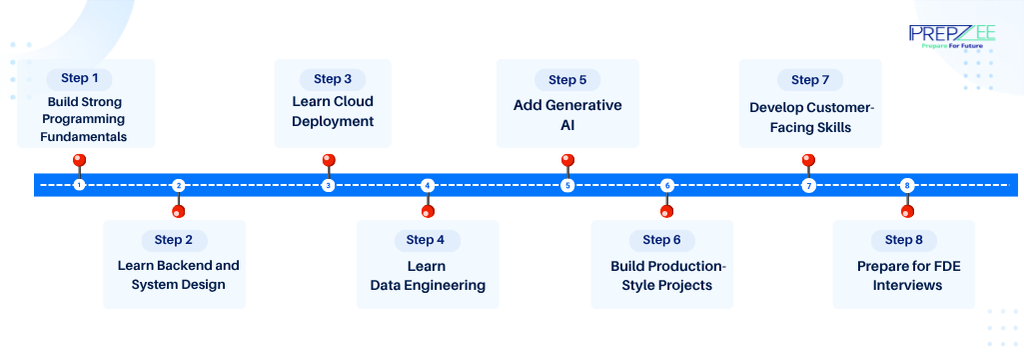
A practical roadmap looks like this:
Step 1: Build Strong Programming Fundamentals
Start with Python, Git, SQL, APIs, debugging, and basic data structures.
Step 2: Learn Backend and System Design
Understand databases, REST APIs, authentication, caching, scalability, and distributed system fundamentals.
Step 3: Learn Cloud Deployment
Choose AWS, Azure, or Google Cloud and learn how applications are deployed in real environments.
Add Docker, Linux, CI/CD, and monitoring skills.
Step 4: Learn Data Engineering
Building strong data engineering skills can help you understand how enterprise data is collected, transformed, and delivered to AI applications.
Step 5: Add Generative AI
If you want a more structured sequence for learning RAG, AI agents, model deployment, and responsible AI, follow this AI-103 learning path.
Step 6: Build Production-Style Projects
Avoid building only simple tutorial projects.
For example, instead of a basic chatbot, build an enterprise RAG application with document ingestion, authentication, search, evaluation, monitoring, and cloud deployment.
Step 7: Develop Customer-Facing Skills
Practice requirements gathering, technical presentations, documentation, and explaining architecture to non-technical stakeholders.
Step 8: Prepare for FDE Interviews
Expect a combination of:
- Coding
- System design
- Problem solving
- Technical architecture
- Customer scenarios
- Behavioral questions
Employers often want to see how you work through ambiguous problems, not only whether you can write code.
For a complete step-by-step learning plan, see our Forward Deployed Engineer roadmap for 2026
Is Forward Deployed Engineering a Good Career in 2026?
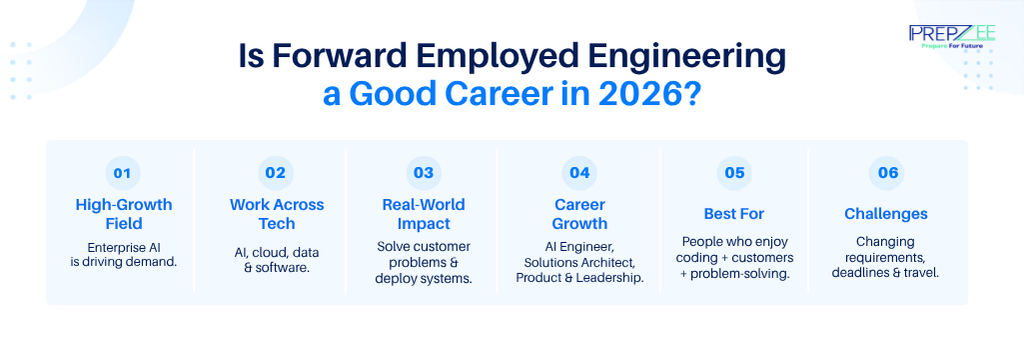
For the right person, yes.
The growth of enterprise AI has created a major gap between powerful technology and successful real-world implementation.
Companies increasingly need engineers who can bridge that gap.
FDEs can work on challenging technical problems, interact with major customers, and gain experience across software engineering, AI, cloud, data, and business strategy.
The career may also lead to roles in:
- AI engineering
- Solutions architecture
- Engineering leadership
- Product management
- Technical consulting
- Startup engineering
However, FDE is not ideal for everyone.
The role can involve changing requirements, demanding customers, tight deadlines, and sometimes travel.
If you prefer working only on well-defined product features with minimal customer interaction, traditional software engineering may be a better fit.
But if you enjoy coding, solving business problems, working with customers, and deploying real systems, Forward Deployed Engineering can be one of the most promising technical career paths in 2026.
Final Takeaway
A Forward Deployed Engineer combines the depth of a software engineer with the customer understanding of a solutions professional.
The role is becoming especially important as companies adopt Generative AI and need engineers who can turn AI platforms into secure, production-ready business solutions.
To prepare for an FDE career, focus on software engineering, cloud, data, system design, and Generative AI, then prove your skills by building realistic end-to-end projects.
Frequently Asked Questions
FAQ
FDE stands for Forward Deployed Engineer. It refers to an engineer who works closely with customers to understand their technical problems and build, integrate, and deploy software or AI solutions in real-world environments.
A Forward Deployed Engineer is usually a strong software engineer, but the role is more customer-facing. While traditional software engineers primarily build core product features, FDEs often build customer-specific integrations, applications, and production deployments.
FDEs commonly need Python or another programming language, SQL, APIs, databases, cloud platforms, system design, Docker, data engineering fundamentals, and strong communication skills. AI-focused roles may also require knowledge of LLMs, RAG, AI agents, and AI deployment.
Not every FDE position requires AI expertise. However, AI and Generative AI skills are becoming increasingly valuable for FDE roles at AI companies. Knowledge of LLMs, RAG, vector databases, AI agents, evaluation, and production AI deployment can provide a strong advantage.
Forward Deployed Engineer compensation varies by company, location, and experience. Many US roles offer six-figure salaries, while experienced engineers working for leading AI and enterprise technology companies can earn significantly more when equity and bonuses are included.
Yes, coding is a core requirement for most FDE positions. Forward Deployed Engineers may build APIs, integrations, data pipelines, backend services, AI applications, and other production systems rather than only advising customers.
Companies such as Palantir, OpenAI, and Scale AI hire Forward Deployed Engineers or professionals in closely related roles. Similar positions may also be called Forward Deployed Software Engineer, AI Solutions Engineer, Customer Engineer, Deployment Engineer, or Applied AI Engineer.
Start by developing strong programming, SQL, API, system design, cloud, and deployment skills. Then gain experience with data engineering and Generative AI, build production-style projects, and improve your ability to gather requirements and communicate technical solutions to customers.
Siddharth Sharma